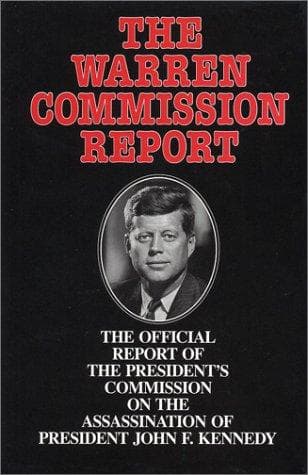
Report of the President's Commission on the Assassination of President John F. KennedyUnited States. Warren Commission
History
Report of the President's Commission on the Assassination of President John F. Kennedy
United States. Warren Commission
Kennedy, John F. (John Fitzgerald), 1917-1963 -- Assassination; Oswald, Lee Harvey
Under this policy, news representatives ordinarily had access to the
Police and Courts Building. The first newsmen to arrive on Friday
afternoon were admitted in accordance with the policy; others who
came later simply followed behind them. Shortly after Oswald arrived,
Captain King granted permission to bring television cameras to the
third floor.[C5-182] By the time the unwieldy proportions of the crowd
of newsmen became apparent, it had already become well entrenched on
the third floor. No one suggested reversing the department’s policy
expressed in General Order No. 81. Chief Curry testified that at no
time did he consider clearing the crowd from the building; he “saw no
particular harm in allowing the media to observe the prisoner.”[C5-183]
Captain King later stated candidly that he simply became “accustomed to
the idea of them being out there.”[C5-184]
The general policy of the Dallas police recognized that the rule
of full cooperation did not apply when it might jeopardize an
investigation.[C5-185] In retrospect, most members of the department
believed that the general rule allowing admittance of the press to the
police quarters should not have been followed after the assassination.
Few, if any, thought this at the time.[C5-186] By failing to exclude
the press from the building on Friday and Saturday, the Dallas police
made it possible for the uncontrolled crowd to nearly surround Oswald
on the frequent occasions that he moved through the third floor
corridor. The decision to allow newsmen to observe the transfer on
Sunday followed naturally the policy established during these first 2
days of Oswald’s detention.
The reporters and cameramen descended upon the third floor of the
Police and Courts Building in such numbers that the pressroom on the
third floor proved wholly inadequate. Rather than the “two or three
or maybe a half dozen reporters” who normally appeared to cover local
police stories,[C5-187] the police were faced with upward of 100.
Bringing with them cameras, microphones, cables, and spotlights, the
newsmen inevitably spilled over into areas where they interfered
with the transaction of police business and the maintenance of
security.[C5-188]
Aside from numbers, the gathering of reporters presented a problem
because most of them were representatives of the national and foreign
press, rather than the local press.[C5-189] These newsmen carried
individual press cards rather than identification cards issued by the
Dallas police. Therefore, it was impossible for the police to verify
quickly the identity of this great number of unfamiliar people who
appeared almost simultaneously.[C5-190] Because of the close physical
proximity of the milling mass of insistent newsmen to the prisoner, the
failure to authenticate press credentials subjected the prisoner to a
serious security risk.
Public-domain text, read in full here on John Shaqi.
Reviews
Reviews
No reviews yet
Be the first to share your thoughts on this work.
Elsewhere in the archive
Join the Discussion
Join the discussion
Sign in to leave a comment or review.
Sign InorCreate an account