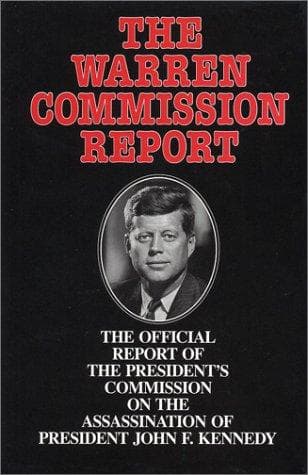
Report of the President's Commission on the Assassination of President John F. KennedyUnited States. Warren Commission
History
Report of the President's Commission on the Assassination of President John F. Kennedy
United States. Warren Commission
Kennedy, John F. (John Fitzgerald), 1917-1963 -- Assassination; Oswald, Lee Harvey
Although steps were taken on Friday afternoon to insure that persons
seeking entry to the third floor were there for a legitimate purpose,
reasons could be fabricated. Moreover, because of the large crowd,
it was easier for unauthorized persons to slip by those guarding
the entrances. Jack Ruby, for one, was able to gain entry to the
third-floor corridor on Friday night.[C5-191]
The third-floor corridor provided the only passageway between the
homicide and robbery bureau and the jail elevator. No thought seems to
have been given, however, to the possibility of questioning Oswald on
some other floor.[C5-192] Moreover, Oswald’s most extended exposure to
the press, at the Friday evening press conference, was unrelated to any
phase of the investigation and was motivated primarily by the desire to
satisfy the demands of the news media to see the prisoner.[C5-193] The
risks attendant upon this appearance were emphasized by the presence of
unauthorized persons, including Jack Ruby, at the press conference in
the basement assembly room.[C5-194]
Although Oswald was repeatedly exposed to possible assaults on Friday
and Saturday, he met his death on Sunday, when police took the most
extensive security precautions. The assembly of more than 70 police
officers, some of them armed with tear gas, and the contemplated use
of an armored truck, appear to have been designed primarily to repel
an attempt of a mob to seize the prisoner.[C5-195] Chief Curry’s own
testimony indicated that such a focus resulted not from any appraisal
of the varied risks to Oswald’s life but came about in response to the
telephone threat Sunday morning that a hundred men were going to attack
Oswald.[C5-196]
A more balanced appraisal would have given thought to protection
against any attack. For example, the acceptance of inadequate press
credentials posed a clear avenue for a one-man assault. The likelihood
of an unauthorized person obtaining entry by such means is confirmed
not alone by the fact that Jack Ruby managed to get by a guard at one
entrance. Several newsmen related that their credentials were not
checked as they entered the basement Sunday morning. Seconds before
Oswald was shot, the double doors from the hallway next to the jail
office afforded a means of entry to the basement without presentation
of credentials earlier demanded of newsmen.[C5-197]
The swarm of newspeople in the basement also substantially limited the
ability of the police to detect an unauthorized person, once he had
entered the basement. While Jack Ruby might have been easily spotted
if only police officers had been in the basement,[C5-198] he remained
apparently unnoticed in the crowd of newsmen until he lunged forward
toward Oswald. The near-blinding television and motion picture lights
which were allowed to shine upon the escort party further increased the
difficulty of observing unusual movements in the basement.
Public-domain text, read in full here on John Shaqi.
Reviews
Reviews
No reviews yet
Be the first to share your thoughts on this work.
Elsewhere in the archive
Join the Discussion
Join the discussion
Sign in to leave a comment or review.
Sign InorCreate an account