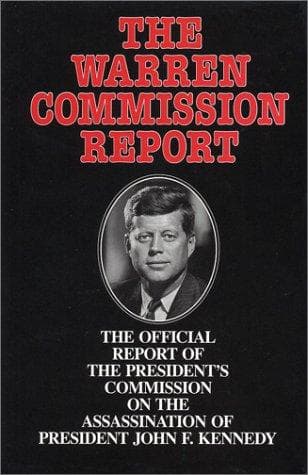
Report of the President's Commission on the Assassination of President John F. KennedyUnited States. Warren Commission
History
Report of the President's Commission on the Assassination of President John F. Kennedy
United States. Warren Commission
Kennedy, John F. (John Fitzgerald), 1917-1963 -- Assassination; Oswald, Lee Harvey
The burden of insuring that appropriate action is taken to establish
ethical standards of conduct for the news media must also be borne,
however, by State and local governments, by the bar, and ultimately
by the public. The experience in Dallas during November 22-24 is a
dramatic affirmation of the need for steps to bring about a proper
balance between the right of the public to be kept informed and the
right of the individual to a fair and impartial trial.
CHAPTER VI
Investigation of Possible Conspiracy
This chapter sets forth the findings of the Commission as to whether
Lee Harvey Oswald had any accomplices in the planning or execution of
the assassination. Particularly after the slaying of Oswald by Jack
Ruby under the circumstances described in the preceding chapter, rumors
and suspicions developed regarding the existence of a conspiracy to
assassinate President Kennedy. As discussed in appendix XII, many of
these rumors were based on a lack of information as to the nature and
extent of evidence that Oswald alone fired the shots which killed
President Kennedy and wounded Governor Connally. Others of the more
widely publicized rumors maintained that Oswald must have received aid
from one or more persons or political groups, ranging from the far
left to the far right of the political spectrum, or from a foreign
government, usually either the Castro regime in Cuba or the Soviet
Union.
The Commission faced substantial difficulties in determining whether
anyone conspired with or assisted the person who committed the
assassination. Prior to his own death Oswald had neither admitted his
own involvement nor implicated any other persons in the assassination
of the President. The problem of determining the existence or
nonexistence of a conspiracy was compounded because of the possibility
of subversive activity by a foreign power. Witnesses and evidence
located in other countries were not subject to subpena, as they would
have been if they had been located in the United States. When evidence
was obtained from a foreign nation, it could not be appraised as
effectively as if it had been derived from a domestic source. The
Commission has given the closest scrutiny to all available evidence
which related or might have related to a foreign country. All such
evidence was tested, whenever possible, against the contingency that it
had been fabricated or slanted to mislead or confuse.
Public-domain text, read in full here on John Shaqi.
Reviews
Reviews
No reviews yet
Be the first to share your thoughts on this work.
Elsewhere in the archive
Join the Discussion
Join the discussion
Sign in to leave a comment or review.
Sign InorCreate an account