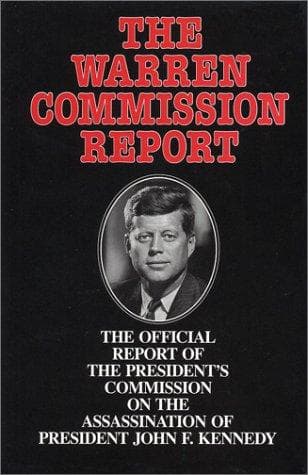
Report of the President's Commission on the Assassination of President John F. KennedyUnited States. Warren Commission
History
Report of the President's Commission on the Assassination of President John F. Kennedy
United States. Warren Commission
Kennedy, John F. (John Fitzgerald), 1917-1963 -- Assassination; Oswald, Lee Harvey
Although the Commission has found no corroboration in the video and
audio tapes, police officials recall that one or two representatives of
the press reinforced their demands to see Oswald by suggesting that the
police had been guilty of brutalizing him. They intimated that unless
they were given the opportunity to see him, these suggestions would be
passed on to the public.[C5-263] Captain King testified that he had
been told that
A short time after Oswald’s arrest one newsman held up a
photograph and said, “This is what the man charged with the
assassination of the President looks like. Or at least this is
what he did look like. We don’t know what he looks like after
an hour in the custody of the Dallas Police Department.”[C5-264]
City Manager Elgin Crull stated that when he visited Chief Curry in
his office on the morning of November 23, Curry told him that he “felt
it was necessary to cooperate with the news media representatives, in
order to avoid being accused of using Gestapo tactics in connection
with the handling of Oswald.” Crull agreed with Curry.[C5-265] The
Commission deems any such veiled threats to be absolutely without
justification.
The general disorder in the Police and Courts Building during November
22-24 reveals a regrettable lack of self-discipline by the newsmen.
The Commission believes that the news media, as well as the police
authorities, who failed to impose conditions more in keeping with the
orderly process of justice, must share responsibility for the failure
of law enforcement which occurred in connection with the death of
Oswald. On previous occasions, public bodies have voiced the need
for the exercise of self-restraint by the news media in periods when
the demand for information must be tempered by other fundamental
requirements of our society.
At its annual meeting in Washington in April 1964, the American
Society of Newspaper Editors discussed the role of the press in Dallas
immediately after President Kennedy’s assassination. The discussion
revealed the strong misgivings among the editors themselves about the
role that the press had played and their desire that the press display
more self-discipline and adhere to higher standards of conduct in the
future.[C5-266] To prevent a recurrence of the unfortunate events which
followed the assassination, however, more than general concern will be
needed. The promulgation of a code of professional conduct governing
representatives of all news media would be welcome evidence that the
press had profited by the lesson of Dallas.
Public-domain text, read in full here on John Shaqi.
Reviews
Reviews
No reviews yet
Be the first to share your thoughts on this work.
Elsewhere in the archive
Join the Discussion
Join the discussion
Sign in to leave a comment or review.
Sign InorCreate an account