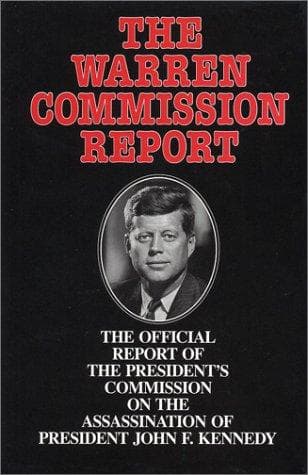
Report of the President's Commission on the Assassination of President John F. KennedyUnited States. Warren Commission
History
Report of the President's Commission on the Assassination of President John F. Kennedy
United States. Warren Commission
Kennedy, John F. (John Fitzgerald), 1917-1963 -- Assassination; Oswald, Lee Harvey
McDonald ordered the man to his feet and heard him say, “Well, it’s all
over now.” The man drew a gun from his waist with one hand and struck
the officer with the other. McDonald struck out with his right hand and
grabbed the gun with his left hand. After a brief struggle McDonald and
several other police officers disarmed and handcuffed the suspect and
drove him to police headquarters, arriving at approximately 2 p.m.
Following the assassination, police cars had rushed to the Texas School
Book Depository in response to the many radio messages reporting that
the shots had been fired from the Depository Building. Inspector J.
Herbert Sawyer of the Dallas Police Department arrived at the scene
shortly after hearing the first of these police radio messages at 12:34
p.m. Some of the officers who had been assigned to the area of Elm
and Houston Streets for the motorcade were talking to witnesses and
watching the building when Sawyer arrived. Sawyer entered the building
and rode a passenger elevator to the fourth floor, which was the top
floor for this elevator. He conducted a quick search, returned to the
main floor and, between approximately 12:37 and 12:40 p.m., ordered
that no one be permitted to leave the building.
Shortly before 1 p.m. Capt. J. Will Fritz, chief of the homicide and
robbery bureau of the Dallas Police Department, arrived to take charge
of the investigation. Searching the sixth floor, Deputy Sheriff Luke
Mooney noticed a pile of cartons in the southeast corner. He squeezed
through the boxes and realized immediately that he had discovered the
point from which the shots had been fired. On the floor were three
empty cartridge cases. A carton had apparently been placed on the floor
at the side of the window so that a person sitting on the carton could
look down Elm Street toward the overpass and scarcely be noticed from
the outside. Between this carton and the half-open window were three
additional cartons arranged at such an angle that a rifle resting on
the top carton would be aimed directly at the motorcade as it moved
away from the building. The high stack of boxes, which first attracted
Mooney’s attention, effectively screened a person at the window from
the view of anyone else on the floor.
Public-domain text, read in full here on John Shaqi.
Reviews
Reviews
No reviews yet
Be the first to share your thoughts on this work.
Join the Discussion
Join the discussion
Sign in to leave a comment or review.
Sign InorCreate an account