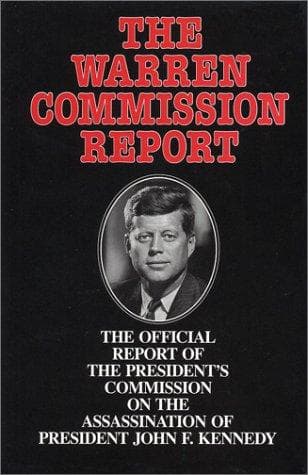
Report of the President's Commission on the Assassination of President John F. Kennedy — John Shaqi
Report of the President's Commission on the Assassination of President John F. KennedyUnited States. Warren Commission
History
Report of the President's Commission on the Assassination of President John F. Kennedy
United States. Warren Commission
Kennedy, John F. (John Fitzgerald), 1917-1963 -- Assassination; Oswald, Lee Harvey
The events of these 2 days were witnessed with shock and disbelief
by a Nation grieving the loss of its young leader. Throughout the
world, reports on these events were disseminated in massive detail.
Theories and speculations mounted regarding the assassination. In many
instances, the intense public demand for facts was met by partial
and frequently conflicting reports from Dallas and elsewhere. After
Oswald’s arrest and his denial of all guilt, public attention focused
both on the extent of the evidence against him and the possibility of
a conspiracy, domestic or foreign. His subsequent death heightened
public interest and stimulated additional suspicions and rumors.
THE COMMISSION AND ITS POWERS
After Lee Harvey Oswald was shot by Jack Ruby, it was no longer
possible to arrive at the complete story of the assassination through
normal judicial procedures during a trial of the alleged assassin.
Alternative means for instituting a complete investigation were widely
discussed. Federal and State officials conferred on the possibility of
initiating a court of inquiry before a State magistrate in Texas. An
investigation by the grand jury of Dallas County also was considered.
As speculation about the existence of a foreign or domestic conspiracy
became widespread, committees in both Houses of Congress weighed the
desirability of congressional hearings to discover all the facts
relating to the assassination.
By his order of November 29 establishing the Commission, President
Johnson sought to avoid parallel investigations and to concentrate
factfinding in a body having the broadest national mandate. As Chairman
of the Commission, President Johnson selected Earl Warren, Chief
Justice of the United States, former Governor and attorney general of
the State of California. From the U.S. Senate, he chose Richard B.
Russell, Democratic Senator from Georgia and chairman of the Senate
Armed Services Committee, former Governor of, and county attorney in,
the State of Georgia, and John Sherman Cooper, Republican Senator
from Kentucky, former county and circuit judge, State of Kentucky,
and U.S. Ambassador to India. Two members of the Commission were
drawn from the U.S. House of Representatives: Hale Boggs, Democratic
U.S. Representative from Louisiana and majority whip, and Gerald R.
Ford, Republican, U.S. Representative from Michigan and chairman of
the House Republican Conference. From private life, President Johnson
selected two lawyers by profession, both of whom have served in the
administrations of Democratic and Republican Presidents: Allen W.
Dulles, former Director of Central Intelligence, and John J. McCloy,
former President of the International Bank for Reconstruction and
Development, former U.S. High Commissioner for Germany, and during
World War II, the Assistant Secretary of War.
Public-domain text, read in full here on John Shaqi.
Reviews
Reviews
No reviews yet
Be the first to share your thoughts on this work.
Join the Discussion
Join the discussion
Sign in to leave a comment or review.
Sign InorCreate an account