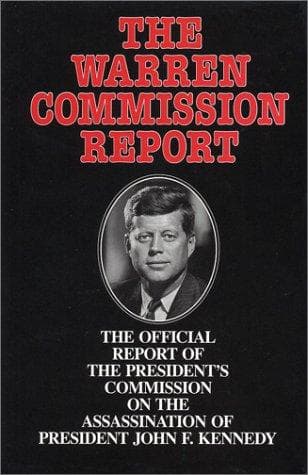
Report of the President's Commission on the Assassination of President John F. Kennedy — John Shaqi
Report of the President's Commission on the Assassination of President John F. KennedyUnited States. Warren Commission
History
Report of the President's Commission on the Assassination of President John F. Kennedy
United States. Warren Commission
Kennedy, John F. (John Fitzgerald), 1917-1963 -- Assassination; Oswald, Lee Harvey
In May 1953, after having been at Youth House for 3 weeks, Lee Oswald
returned to school where his attendance and grades temporarily
improved. By the following fall, however, the probation officer
reported that virtually every teacher complained about the boy’s
behavior. His mother insisted that he did not need psychiatric
assistance. Although there was apparently some improvement in Lee’s
behavior during the next few months, the court recommended further
treatment. In January 1954, while Lee’s case was still pending,
Marguerite and Lee left for New Orleans, the city of Lee’s birth.
Upon his return to New Orleans, Lee maintained mediocre grades but
had no obvious behavior problems. Neighbors and others who knew him
outside of school remembered him as a quiet, solitary and introverted
boy who read a great deal and whose vocabulary made him quite
articulate. About 1 month after he started the 10th grade and 11 days
before his 16th birthday in October 1955, he brought to school a note
purportedly written by his mother, stating that the family was moving
to California. The note was written by Lee. A few days later he dropped
out of school and almost immediately tried to join the Marine Corps.
Because he was only 16, he was rejected.
After leaving school Lee worked for the next 10 months at several jobs
in New Orleans as an office messenger or clerk. It was during this
period that he started to read communist literature. Occasionally,
in conversations with others, he praised communism and expressed to
his fellow employees a desire to join the Communist Party. At about
this time, when he was not yet 17, he wrote to the Socialist Party of
America, professing his belief in Marxism.
Another move followed in July 1956 when Lee and his mother returned
to Fort Worth. He reentered high school but again dropped out after
a few weeks and enlisted in the Marine Corps on October 24, 1956, 6
days after his 17th birthday. On December 21, 1956, during boot camp
in San Diego, Oswald fired a score of 212 for record with the M-1
rifle--2 points over the minimum for a rating of “sharpshooter” on a
marksman/sharpshooter/expert scale. After his basic training, Oswald
received training in aviation fundamentals and then in radar scanning.
Most people who knew Oswald in the Marines described him as a “loner”
who resented the exercise of authority by others. He spent much of
his free time reading. He was court-martialed once for possessing an
unregistered privately owned weapon and, on another occasion, for using
provocative language to a noncommissioned officer. He was, however,
generally able to comply with Marine discipline, even though his
experiences in the Marine Corps did not live up to his expectations.
Public-domain text, read in full here on John Shaqi.
Reviews
Reviews
No reviews yet
Be the first to share your thoughts on this work.
Join the Discussion
Join the discussion
Sign in to leave a comment or review.
Sign InorCreate an account