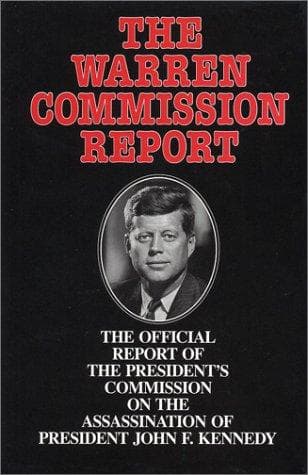
Report of the President's Commission on the Assassination of President John F. KennedyUnited States. Warren Commission
History
Report of the President's Commission on the Assassination of President John F. Kennedy
United States. Warren Commission
Kennedy, John F. (John Fitzgerald), 1917-1963 -- Assassination; Oswald, Lee Harvey
The purpose of the accumulated fund soon became known. On October 16,
1959, Oswald arrived in Moscow by train after crossing the border
from Finland, where he had secured a visa for a 6-day stay in the
Soviet Union. He immediately applied for Soviet citizenship. On the
afternoon of October 21, 1959, Oswald was ordered to leave the Soviet
Union by 8 p.m. that evening. That same afternoon in his hotel room
Oswald, in an apparent suicide attempt, slashed his left wrist. He
was hospitalized immediately. On October 31, 3 days after his release
from the hospital, Oswald appeared at the American Embassy, announced
that he wished to renounce his U.S. citizenship and become a Russian
citizen, and handed the Embassy officer a written statement he had
prepared for the occasion. When asked his reasons, Oswald replied, “I
am a Marxist.” Oswald never formally complied with the legal steps
necessary to renounce his American citizenship. The Soviet Government
did not grant his request for citizenship, but in January 1960 he was
given permission to remain in the Soviet Union on a year-to-year basis.
At the same time Oswald was sent to Minsk where he worked in a radio
factory as an unskilled laborer. In January 1961 his permission to
remain in the Soviet Union was extended for another year. A few weeks
later, in February 1961, he wrote to the American Embassy in Moscow
expressing a desire to return to the United States.
The following month Oswald met a 19-year-old Russian girl, Marina
Nikolaevna Prusakova, a pharmacist, who had been brought up in
Leningrad but was then living with an aunt and uncle in Minsk. They
were married on April 30, 1961. Throughout the following year he
carried on a correspondence with American and Soviet authorities
seeking approval for the departure of himself and his wife to the
United States. In the course of this effort, Oswald and his wife
visited the U.S. Embassy in Moscow in July of 1961. Primarily on the
basis of an interview and questionnaire completed there, the Embassy
concluded that Oswald had not lost his citizenship, a decision
subsequently ratified by the Department of State in Washington, D.C.
Upon their return to Minsk, Oswald and his wife filed with the Soviet
authorities for permission to leave together. Their formal application
was made in July 1961, and on December 25, 1961, Marina Oswald was
advised it would be granted.
Public-domain text, read in full here on John Shaqi.
Reviews
Reviews
No reviews yet
Be the first to share your thoughts on this work.
Join the Discussion
Join the discussion
Sign in to leave a comment or review.
Sign InorCreate an account