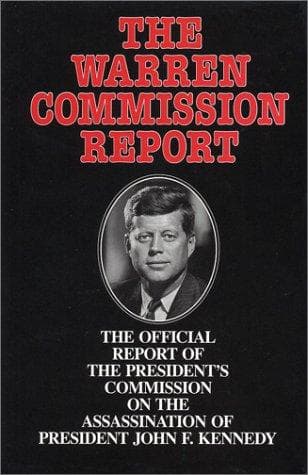
Report of the President's Commission on the Assassination of President John F. Kennedy — John Shaqi
Report of the President's Commission on the Assassination of President John F. KennedyUnited States. Warren Commission
History
Report of the President's Commission on the Assassination of President John F. Kennedy
United States. Warren Commission
Kennedy, John F. (John Fitzgerald), 1917-1963 -- Assassination; Oswald, Lee Harvey
During the morning of November 22, Marina Oswald followed President
Kennedy’s activities on television. She and Ruth Paine cried when they
heard that the President had been shot. Ruth Paine translated the news
of the shooting to Marina Oswald as it came over television, including
the report that the shots were probably fired from the building where
Oswald worked. When Marina Oswald heard this, she recalled the Walker
episode and the fact that her husband still owned the rifle. She went
quietly to the Paine’s garage where the rifle had been concealed in a
blanket among their other belongings. It appeared to her that the rifle
was still there, although she did not actually open the blanket.
At about 3 p.m. the police arrived at the Paine house and asked Marina
Oswald whether her husband owned a rifle. She said that he did and then
led them into the garage and pointed to the rolled up blanket. As a
police officer lifted it, the blanket hung limply over either side of
his arm. The rifle was not there.
Meanwhile, at police headquarters, Captain Fritz had begun questioning
Oswald. Soon after the start of the first interrogation, agents of
the FBI and the U.S. Secret Service arrived and participated in the
questioning. Oswald denied having anything to do with the assassination
of President Kennedy or the murder of Patrolman Tippit. He claimed that
he was eating lunch at the time of the assassination, and that he then
spoke with his foreman for 5 to 10 minutes before going home. He denied
that he owned a rifle and when confronted, in a subsequent interview,
with a picture showing him holding a rifle and pistol, he claimed that
his face had been superimposed on someone else’s body. He refused to
answer any questions about the presence in his wallet of a selective
service card with his picture and the name “Alek J. Hidell.”
During the questioning of Oswald on the third floor of the police
department, more than 100 representatives of the press, radio, and
television were crowded into the hallway through which Oswald had
to pass when being taken from his cell to Captain Fritz’ office for
interrogation. Reporters tried to interview Oswald during these
trips. Between Friday afternoon and Sunday morning he appeared in the
hallway at least 16 times. The generally confused conditions outside
and inside Captain Fritz’ office increased the difficulty of police
questioning. Advised by the police that he could communicate with an
attorney, Oswald made several telephone calls on Saturday in an effort
to procure representation of his own choice and discussed the matter
with the president of the local bar association, who offered to obtain
counsel. Oswald declined the offer saying that he would first try to
obtain counsel by himself. By Sunday morning he had not yet engaged an
attorney.
Public-domain text, read in full here on John Shaqi.
Reviews
Reviews
No reviews yet
Be the first to share your thoughts on this work.
Join the Discussion
Join the discussion
Sign in to leave a comment or review.
Sign InorCreate an account