Report of the President's Commission on the Assassination of President John F. Kennedy — John Shaqi
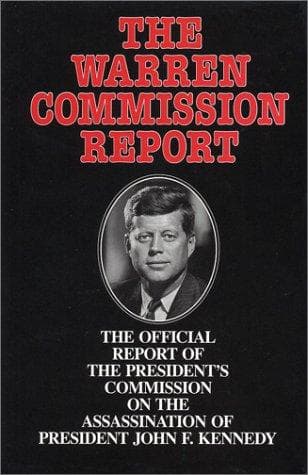
Report of the President's Commission on the Assassination of President John F. KennedyUnited States. Warren Commission
History
Report of the President's Commission on the Assassination of President John F. Kennedy
United States. Warren Commission
Kennedy, John F. (John Fitzgerald), 1917-1963 -- Assassination; Oswald, Lee Harvey
5. Oswald killed Dallas Police Patrolman J. D. Tippit approximately 45
minutes after the assassination. This conclusion upholds the finding
that Oswald fired the shots which killed President Kennedy and wounded
Governor Connally and is supported by the following:
(_a_) Two eyewitnesses saw the Tippit shooting and seven
eyewitnesses heard the shots and saw the gunman leave the scene
with revolver in hand. These nine eyewitnesses positively
identified Lee Harvey Oswald as the man they saw.
(_b_) The cartridge cases found at the scene of the shooting
were fired from the revolver in the possession of Oswald at the
time of his arrest to the exclusion of all other weapons.
(_c_) The revolver in Oswald’s possession at the time of his
arrest was purchased by and belonged to Oswald.
(_d_) Oswald’s jacket was found along the path of flight taken
by the gunman as he fled from the scene of the killing.
6. Within 80 minutes of the assassination and 35 minutes of the Tippit
killing Oswald resisted arrest at the theatre by attempting to shoot
another Dallas police officer.
7. The Commission has reached the following conclusions concerning
Oswald’s interrogation and detention by the Dallas police:
(_a_) Except for the force required to effect his arrest,
Oswald was not subjected to any physical coercion by any law
enforcement officials. He was advised that he could not be
compelled to give any information and that any statements made
by him might be used against him in court. He was advised of
his right to counsel. He was given the opportunity to obtain
counsel of his own choice and was offered legal assistance by
the Dallas Bar Association, which he rejected at that time.
(_b_) Newspaper, radio, and television reporters were allowed
uninhibited access to the area through which Oswald had to
pass when he was moved from his cell to the interrogation room
and other sections of the building, thereby subjecting Oswald
to harassment and creating chaotic conditions which were not
conducive to orderly interrogation or the protection of the
rights of the prisoner.
(_c_) The numerous statements, sometimes erroneous, made to
the press by various local law enforcement officials, during
this period of confusion and disorder in the police station,
would have presented serious obstacles to the obtaining of
a fair trial for Oswald. To the extent that the information
was erroneous or misleading, it helped to create doubts,
speculations, and fears in the mind of the public which might
otherwise not have arisen.
8. The Commission has reached the following conclusions concerning the
killing of Oswald by Jack Ruby on November 24, 1963:
(_a_) Ruby entered the basement of the Dallas Police Department
shortly after 11:17 a.m. and killed Lee Harvey Oswald at 11:21
a.m.
Public-domain text, read in full here on John Shaqi.
Reviews
Reviews
No reviews yet
Be the first to share your thoughts on this work.
Join the Discussion
Join the discussion
Sign in to leave a comment or review.
Sign InorCreate an account