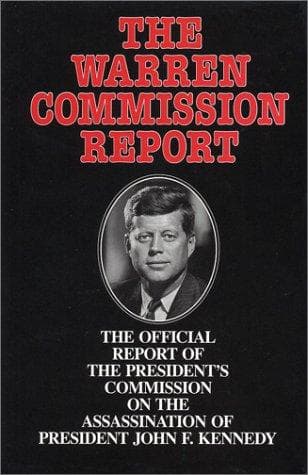
Report of the President's Commission on the Assassination of President John F. KennedyUnited States. Warren Commission
History
Report of the President's Commission on the Assassination of President John F. Kennedy
United States. Warren Commission
Kennedy, John F. (John Fitzgerald), 1917-1963 -- Assassination; Oswald, Lee Harvey
Upon arriving at Parkland Hospital, Lawson jumped from the lead car and
rushed into the emergency entrance, where he was met by hospital staff
members wheeling stretchers out to the automobile.[C2-187] Special
Agent Hill removed his suit jacket and covered the President’s head
and upper chest to prevent the taking of photographs.[C2-188] Governor
Connally, who had lost consciousness on the ride to the hospital,
regained consciousness when the limousine stopped abruptly at the
emergency entrance. Despite his serious wounds, Governor Connally tried
to get out of the way so that medical help could reach the President.
Although he was reclining in his wife’s arms, he lurched forward in
an effort to stand upright and get out of the car, but he collapsed
again. Then he experienced his first sensation of pain, which became
excruciating.[C2-189] The Governor was lifted onto a stretcher and
taken into trauma room 2.[C2-190] For a moment, Mrs. Kennedy refused to
release the President, whom she held in her lap, but then Kellerman,
Greer, and Lawson lifted the President onto a stretcher and pushed it
into trauma room 1.[C2-191]
Treatment of President Kennedy
The first physician to see the President at Parkland Hospital was Dr.
Charles J. Carrico, a resident in general surgery.[C2-192] Dr. Carrico
was in the emergency area, examining another patient, when he was
notified that President Kennedy was en route to the hospital.[C2-193]
Approximately 2 minutes later, Dr. Carrico saw the President on his
back, being wheeled into the emergency area.[C2-194] He noted that
the President was blue-white or ashen in color; had slow, spasmodic,
agonal respiration without any coordination; made no voluntary
movements; had his eyes open with the pupils dilated without any
reaction to light; evidenced no palpable pulse; and had a few chest
sounds which were thought to be heart beats.[C2-195] On the basis of
these findings, Dr. Carrico concluded that President Kennedy was still
alive.[C2-196]
Dr. Carrico noted two wounds: a small bullet wound in the front
lower neck, and an extensive wound in the President’s head where
a sizable portion of the skull was missing.[C2-197] He observed
shredded brain tissue and “considerable slow oozing” from the latter
wound, followed by “more profuse bleeding” after some circulation
was established.[C2-198] Dr. Carrico felt the President’s back and
determined that there was no large wound there which would be an
immediate threat to life.[C2-199] Observing the serious problems
presented by the head wound and inadequate respiration, Dr. Carrico
directed his attention to improving the President’s breathing.[C2-200]
He noted contusions, hematoma to the right of the larynx, which was
deviated slightly to the left, and also ragged tissue which indicated
a tracheal injury.[C2-201] Dr. Carrico inserted a cuffed endotracheal
tube past the injury, inflated the cuff, and connected it to a Bennett
machine to assist in respiration.[C2-202]
Public-domain text, read in full here on John Shaqi.
Reviews
Reviews
No reviews yet
Be the first to share your thoughts on this work.
Elsewhere in the archive
Join the Discussion
Join the discussion
Sign in to leave a comment or review.
Sign InorCreate an account