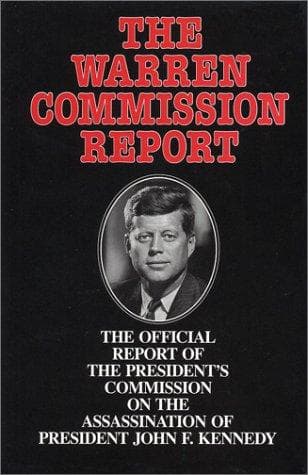
Report of the President's Commission on the Assassination of President John F. KennedyUnited States. Warren Commission
History
Report of the President's Commission on the Assassination of President John F. Kennedy
United States. Warren Commission
Kennedy, John F. (John Fitzgerald), 1917-1963 -- Assassination; Oswald, Lee Harvey
At that point, direction of the President’s treatment was undertaken by
Dr. Malcolm O. Perry, who arrived at trauma room 1 a few moments after
the President.[C2-203] Dr. Perry noted the President’s back brace as
he felt for a femoral pulse, which he did not find.[C2-204] Observing
that an effective airway had to be established if treatment was to be
effective, Dr. Perry performed a tracheotomy, which required 3 to 5
minutes.[C2-205] While Dr. Perry was performing the tracheotomy, Drs.
Carrico and Ronald Jones made cutdowns on the President’s right leg and
left arm, respectively, to infuse blood and fluids into the circulatory
system.[C2-206] Dr. Carrico treated the President’s known adrenal
insufficiency by administering hydrocortisone.[C2-207] Dr. Robert
N. McClelland entered at that point and assisted Dr. Perry with the
tracheotomy.[C2-208]
Dr. Fouad Bashour, chief of cardiology, Dr. M. T. Jenkins, chief
of anesthesiology, and Dr. A. H. Giesecke, Jr., then joined in the
effort to revive the President.[C2-209] When Dr. Perry noted free air
and blood in the President’s chest cavity, he asked that chest tubes
be inserted to allow for drainage of blood and air. Drs. Paul C.
Peters and Charles R. Baxter initiated these procedures.[C2-210] As a
result of the infusion of liquids through the cutdowns, the cardiac
massage, and the airway, the doctors were able to maintain peripheral
circulation as monitored at the neck (carotid) artery and at the wrist
(radial) pulse. A femoral pulse was also detected in the President’s
leg.[C2-211] While these medical efforts were in progress, Dr. Clark
noted some electrical activity on the cardiotachyscope attached to
monitor the President’s heart responses.[C2-212] Dr. Clark, who most
closely observed the head wound, described a large, gaping wound in the
right rear part of the head, with substantial damage and exposure of
brain tissue, and a considerable loss of blood.[C2-213] Dr. Clark did
not see any other hole or wound on the President’s head. According to
Dr. Clark, the small bullet hole on the right rear of the President’s
head discovered during the subsequent autopsy “could have easily been
hidden in the blood and hair.”[C2-214]
Public-domain text, read in full here on John Shaqi.
Reviews
Reviews
No reviews yet
Be the first to share your thoughts on this work.
Elsewhere in the archive
Join the Discussion
Join the discussion
Sign in to leave a comment or review.
Sign InorCreate an account