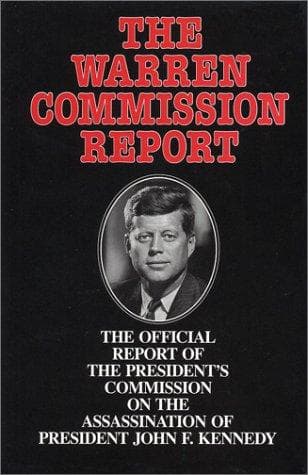
Report of the President's Commission on the Assassination of President John F. KennedyUnited States. Warren Commission
History
Report of the President's Commission on the Assassination of President John F. Kennedy
United States. Warren Commission
Kennedy, John F. (John Fitzgerald), 1917-1963 -- Assassination; Oswald, Lee Harvey
In the absence of any neurological, muscular, or heart response,
the doctors concluded that efforts to revive the President were
hopeless.[C2-215] This was verified by Admiral Burkley, the President’s
physician, who arrived at the hospital after emergency treatment
was underway and concluded that “my direct services to him at that
moment would have interfered with the action of the team which was
in progress.”[C2-216] At approximately 1 p.m., after last rites were
administered to the President by Father Oscar L. Huber, Dr. Clark
pronounced the President dead. He made the official determination
because the ultimate cause of death, the severe head injury, was within
his sphere of specialization.[C2-217] The time was fixed at 1 p.m.,
as an approximation, since it was impossible to determine the precise
moment when life left the President.[C2-218] President Kennedy could
have survived the neck injury, but the head wound was fatal.[C2-219]
From a medical viewpoint, President Kennedy was alive when he arrived
at Parkland Hospital; the doctors observed that he had a heart beat
and was making some respiratory efforts.[C2-220] But his condition was
hopeless, and the extraordinary efforts of the doctors to save him
could not help but to have been unavailing.
Since the Dallas doctors directed all their efforts to controlling the
massive bleeding caused by the head wound, and to reconstructing an
airway to his lungs, the President remained on his back throughout his
medical treatment at Parkland.[C2-221] When asked why he did not turn
the President over, Dr. Carrico testified as follows:
A. This man was in obvious extreme distress and any more
thorough inspection would have involved several minutes--well,
several--considerable time which at this juncture was not
available. A thorough inspection would have involved washing
and cleansing the back, and this is not practical in treating
an acutely injured patient. You have to determine which things,
which are immediately life threatening and cope with them,
before attempting to evaluate the full extent of the injuries.
Q. Did you ever have occasion to look at the President’s back?
A. No, sir. Before--well, in trying to treat an acutely injured
patient, you have to establish an airway, adequate ventilation
and you have to establish adequate circulation. Before this was
accomplished the President’s cardiac activity had ceased and
closed cardiac massage was instituted, which made it impossible
to inspect his back.
Q. Was any effort made to inspect the President’s back after he
had expired?
A. No, sir.
Q. And why was no effort made at that time to inspect his back?
A. I suppose nobody really had the heart to do it.[C2-222]
Moreover, the Parkland doctors took no further action after the
President had expired because they concluded that it was beyond the
scope of their permissible duties.[C2-223]
Public-domain text, read in full here on John Shaqi.
Reviews
Reviews
No reviews yet
Be the first to share your thoughts on this work.
Elsewhere in the archive
Join the Discussion
Join the discussion
Sign in to leave a comment or review.
Sign InorCreate an account