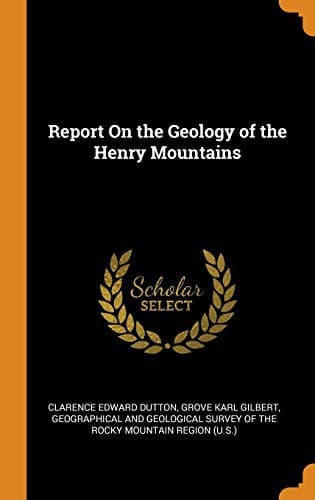
Report on the geology of the Henry MountainsGilbert, Grove Karl
Science
Report on the geology of the Henry Mountains
Gilbert, Grove Karl
Geology -- Utah -- Henry Mountains; Intrusions (Geology) -- Utah -- Henry Mountains
The great solvent of rocks is water, but it receives aid from some other
substances of which it becomes the vehicle. These substances are chiefly
products of the formation and decomposition of vegetable tissues. Some
rocks are disintegrated by their complete solution, but the great
majority are divided into grains by the solution of a portion; and
fragmental rocks usually lose by solution the cement merely, and are
thus reduced to their original incoherent condition.
The most rigid rocks are cracked by sudden changes of temperature; and
the crevices thus begun are opened by the freezing of the water within
them. The coherence of the more porous rocks is impaired and often
destroyed by the same expansive force of freezing water.
The beating of the rain overcomes the feeble coherence of earths, and
assists solution and frost by detaching the particles which they have
partially loosened.
When the base of a cliff is eroded so as to remove or diminish the
support of the upper part, the rock thus deprived of support is broken
off in blocks by gravity. The process of which this is a part is called
cliff erosion or _sapping_.
Plants often pry apart rocks by the growth of their roots, but their
chief aid to erosion is by increasing the solvent power of percolating
water.
In general soft rocks weather more rapidly than hard.
_Transportation._
A portion of the water of rains flows over the surface and is quickly
gathered into streams. A second portion is absorbed by the earth or rock
on which it falls, and after a slow underground circulation reissues in
springs. Both transport the products of weathering, the latter carrying
dissolved minerals and the former chiefly undissolved.
Transportation is also performed by the direct action of gravity. In
sapping, the blocks which are detached by gravity are by the same agency
carried to the base of the cliff.
_Corrasion._
In corrasion the agents of disintegration are solution and mechanical
wear. Wherever the two are combined, the superior efficiency of the
latter is evident; and in all fields of rapid corrasion the part played
by solution is so small that it may be disregarded.
The mechanical wear of streams is performed by the aid of hard mineral
fragments which are carried along by the current. The effective force is
that of the current; the tools are mud, sand, and bowlders. The most
important of them is sand; it is chiefly by the impact and friction of
grains of sand that the rocky beds of streams are disintegrated.
Streams of clear water corrade their beds by solution. Muddy streams act
partly by solution, but chiefly by attrition.
Public-domain text, read in full here on John Shaqi.
Reviews
Reviews
No reviews yet
Be the first to share your thoughts on this work.
Elsewhere in the archive
Join the Discussion
Join the discussion
Sign in to leave a comment or review.
Sign InorCreate an account