Research methods in ecologyClements, Frederic E. (Frederic Edward)
Science
Research methods in ecology
Clements, Frederic E. (Frederic Edward)
Plant ecology; Plant ecology -- Methodology
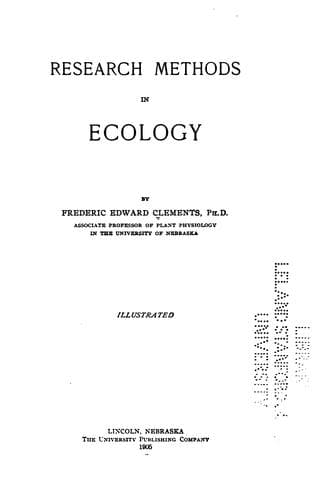
RESEARCH METHODS
IN
ECOLOGY
BY
FREDERIC EDWARD CLEMENTS, PH.D.
ASSOCIATE PROFESSOR OF PLANT PHYSIOLOGY IN THE UNIVERSITY OF NEBRASKA
_ILLUSTRATED_
LINCOLN, NEBRASKA
THE UNIVERSITY PUBLISHING COMPANY
1905
COPYRIGHT, 1905
BY FREDERIC E. CLEMENTS AND IRVING S. CUTTER
All rights reserved
=Press of Jacob North & Company=
LINCOLN, NEBRASKA
PREFACE
The present volume is intended as a handbook for investigators and for
advanced students of ecology, and not as a text-book of the subject. An
elementary text-book covering the same field, but adapted to the needs
of undergraduate students, is in preparation. The handbook is
essentially an account of the methods used by the author in his studies
of the last eight years, during which a serious attempt has been made to
discover and to correlate the fundamental points of view in the vast
field of vegetation. No endeavor is made to treat any portion of the
subject exhaustively, since a discussion of general methods and general
principles is of much greater value in the present condition of ecology.
The somewhat unequal treatment given the different subjects is due to
the fact that it has been found possible to develop some of these more
rapidly than others. Finally, it must be constantly kept in mind that
ecology is still in a very plastic condition, and in consequence,
methods, fundamental principles, and matters of nomenclature and
terminology must be approached without prejudice in order that the best
possible development of this field may be attained.
Grateful acknowledgment for criticisms and suggestions is made to
Professor Doctor Charles E. Bessey and Professor Doctor Roscoe Pound,
who have read the text. The author is under especial obligations to
Doctor Edith S. Clements for the drawings of leaf types, as well as for
reading and criticising the manuscript. Professor Goodwin D. Swezey,
Professor of Astronomy in the University of Nebraska, has kindly
furnished much material for the determination of the sun’s altitude, and
consequent light intensities, and has read the section devoted to light.
Mr. George A. Loveland, Director of the Nebraska Section of the U. S.
Weather Bureau, has contributed many helpful suggestions to the
discussion of meteorological instruments. To Nella Schlesinger, Alice
Venters, and George L. Fawcett, advanced students in experimental
ecology, the author is indebted for many experiments which have been
used in the discussion of adjustment and adaptation.
Public-domain text, read in full here on John Shaqi.
Reviews
Reviews
No reviews yet
Be the first to share your thoughts on this work.
Join the Discussion
Join the discussion
Sign in to leave a comment or review.
Sign InorCreate an account