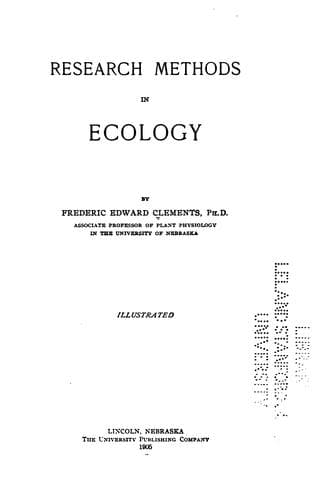
Research methods in ecologyClements, Frederic E. (Frederic Edward)
Science
Research methods in ecology
Clements, Frederic E. (Frederic Edward)
Plant ecology; Plant ecology -- Methodology
A primary requisite for any method for measuring adjustment is that it
be applicable to field conditions. Many instruments for measuring
transpiration, for example, are valueless, not because they are
inaccurate, but because the plant studied is under abnormal conditions.
To avoid the latter is absolutely necessary, a fact which makes it
peculiarly difficult to devise a satisfactory field method. After the
latter has been found and applied, it becomes possible to check other
methods by it, and to give them real value. The final test of a field
method is three-fold: (1) the plant must be studied while functioning
normally in its own habitat; (2) the method must give accurate results;
and (3) it must permit of extensive and fairly convenient application in
the field. Until methods of this character, some of which are described
later, have been employed for some time, it is impossible to connect
definite intensities of factor stimuli with measured amounts of
adjustment. Ultimately, it seems certain that researches will regularly
take this form.
Adaptation is primarily indicated by changes in the arrangement and
character of the cells of the plant. Since these determine the form of
each organ, morphology also furnishes important evidence in regard to
the course of adaptation, but form can be connected certainly with
adjustment only through the study of cellular adaptation. In tracing the
modifications of cell and of tissue, the usual methods of histology,
viz., sectioning and drawing, suffice for the individual. It is merely
necessary to select plants and organs which are as nearly typical as can
be determined. The question of quantity becomes paramount, however,
since it often gives the clue to qualitative changes, and hence it is
imperative that complete and accurate measurements of cells, tissues,
and organs be made. These measurements, when extended to a sufficiently
large number of plants, serve to indicate the direction of adaptation in
the species. They constitute the materials for determining biometrically
the mean of adaptation for the species and the probable evolution of the
latter. In its present development, biometry contains too much
mathematics, and too little biology. This has perhaps been unavoidable,
but it is to be hoped that the future will bring about a wise sifting of
methods, which will make biometry the ready and invaluable servant of
all serious students of experimental evolution. This condition does not
obtain at present, and in consequence it seems unwise to consider the
subject of biometry in this treatise.
Public-domain text, read in full here on John Shaqi.
Reviews
Reviews
No reviews yet
Be the first to share your thoughts on this work.
Elsewhere in the archive
Join the Discussion
Join the discussion
Sign in to leave a comment or review.
Sign InorCreate an account