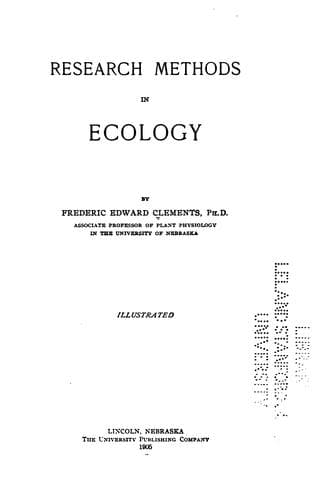
Research methods in ecologyClements, Frederic E. (Frederic Edward)
Science
Research methods in ecology
Clements, Frederic E. (Frederic Edward)
Plant ecology; Plant ecology -- Methodology
=149. Plasticity and fixity.= As the product of accumulated responses,
each species is characterized by a certain ability or inability to react
to stimuli. Many facts seem to indicate that the degree of stability is
connected with the length of time during which the species is acted upon
by the same stimuli. It seems probable that plants which have reacted to
sunlight for hundreds of years will respond less readily to shade than
those which have grown in the sun for a much shorter period. This
hypothesis is not susceptible of proof in nature because it is
ordinarily impossible to distinguish species upon the basis of the time
during which they have occupied one habitat. Evidence and ultimate
proof, perhaps, can be obtained only by field and control experiments,
in which the time of occupation of any habitat is definitely known. Even
in this case, however, it is clear that antecedent habitats will have
left effects which can neither be traced nor ignored. Additional support
is given this view by the fact that extreme types, both ecological and
taxonomic, are the most stable. Intense xerophytes and hydrophytes are
much more fixed than mesophytes, though the intensity of the stimulus
has doubtless as great an influence as its duration. Composites,
labiates, grasses, orchids, etc., are less plastic than ranals, rosals,
etc., but there are many exceptions to the apparent rule that fixity
increases with taxonomic complexity. At present it seems quite
impossible to suggest an explanation of the rule. Recent experiments
indicate that there may be ancestral fixity of function, as well as of
structure. It has been found, for example, that the flowers of certain
species always react normally to the stimuli which produce opening and
closing, while others make extremely erratic response. If further work
confirms this result and extends it to other functions, the necessity of
arriving at a better understanding of fixity will be greatly emphasized.
It is impossible to make progress in the study of adaptation without
recognizing the fundamental importance of ancestral fixity as a factor.
E. S. Clements[9] has shown that a number of species undergo pronounced
changes in habitat without showing appreciable modification.
Consequently, it is incorrect to assume that each habitat puts a
structural impress upon every plant that enters it. For this reason, the
writer feels that the current explanation of xerophytic bog plants,
etc., is probably wrong, and that the discrepancy between the nature of
the habitat and the structure of the plant is to be explained by the
persistence of a fixed ancestral type. The anomaly is scarcely greater
than in cases that have proved capable of being explained.
Public-domain text, read in full here on John Shaqi.
Reviews
Reviews
No reviews yet
Be the first to share your thoughts on this work.
Elsewhere in the archive
Join the Discussion
Join the discussion
Sign in to leave a comment or review.
Sign InorCreate an account