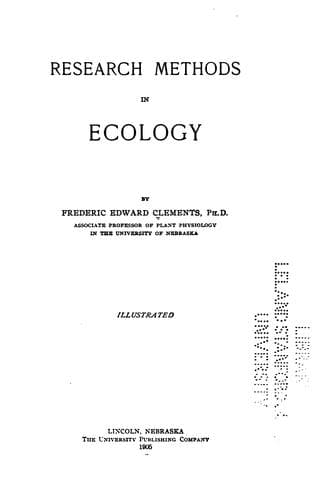
Research methods in ecologyClements, Frederic E. (Frederic Edward)
Science
Research methods in ecology
Clements, Frederic E. (Frederic Edward)
Plant ecology; Plant ecology -- Methodology
=1. The scope of ecology.= The clue to the field of ecology is found in
the Greek word, οἲκος, home. The point of view in the following treatise
is constantly that which is inherent in the term itself. Ecology is
therefore considered the dominant theme in the study of plants, indeed,
as the central and vital part of botany. This statement may at first
appear startling, if not unfounded, but mature reflection will show that
all the questions of botanical science lead sooner or later to the two
ultimate facts: plant and habitat. The essential truth of this has been
much obscured by detached methods of study in physiology, morphology,
and histology, which are too often treated as independent fields. These
have suffered incomplete and unsymmetric development in consequence of
extreme specialistic tendencies. Analytic methods have dominated
research to the exclusion of synthetic ones, which, in a greatly
diversified field, must be final, if botanical knowledge is something to
be systematized and not merely catalogued. Physiology in particular has
suffered at the hands of detached specialists. Originally conceived as
an inquiry into the origin and nature of plants, it has been developed
strictly as a study of plant activities. It all but ignores the physical
factors that control function, and the organs and tissues that reflect
it.
=2. Ecology and physiology.= There can be little question in regard to
the essential identity of physiology and ecology. This is evident when
it is clearly seen that the present difference between the two fields is
superficial. Ecology has been largely the descriptive study of
vegetation; physiology has concerned itself with function; but, when
carefully analyzed, both are seen to rest upon the same foundation. In
each, the development is incomplete: ecology has so far been merely
superficial, physiology too highly specialized. The one is chaotic and
unsystematized, the other too often a minute study of function under
abnormal circumstances. The greatest need of the former is the
introduction of method and system, of the latter, a broadening of scope
and new objectives. The growing recognition of the identity of the two
makes it desirable to anticipate their final merging, and to formulate a
system that will combine the good in each, and at the same time
eliminate superficial and extreme tendencies. In this connection, it
becomes necessary to point out to ecologist and physiologist alike that,
while they have been working on the confines of the same great field,
each must familiarize himself with the work and methods of the other,
before his preparation is complete. Both must broaden their horizons,
and rearrange their views. The ecologist is sadly in need of the more
intimate and exact methods of the physiologist: the latter must take his
experiments into the field, and must recognize more fully that function
is but the middleman between habitat and plant. It seems probable that
Public-domain text, read in full here on John Shaqi.
Reviews
Reviews
No reviews yet
Be the first to share your thoughts on this work.
Join the Discussion
Join the discussion
Sign in to leave a comment or review.
Sign InorCreate an account