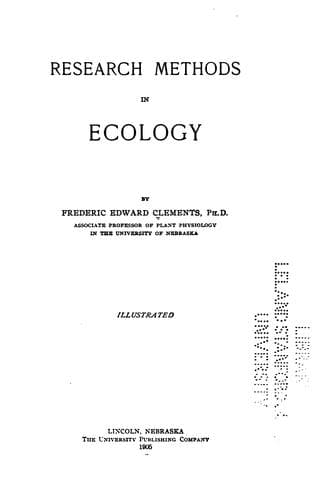
Research methods in ecologyClements, Frederic E. (Frederic Edward)
Science
Research methods in ecology
Clements, Frederic E. (Frederic Edward)
Plant ecology; Plant ecology -- Methodology
Although habitats differ more or less with respect to all their factors,
the study of polydemics needs to take into account only the direct
factors, water-content, humidity, and light. Humidity as a highly
variable factor plays a secondary part, and in consequence the search
for ecads may be entirely confined to those habitats that show efficient
differences in the amount of water-content or of light. Temperature,
wind, etc., do not produce ecads, and may be ignored, except in so far
as they affect the direct factors. Complexes of factors, such as
altitude, slope, and exposure, are likewise effective only through the
action of the component simple factors upon water and light. The
influence of biotic factors is so remote as to be negligible, especially
in view of the fact that ecads are necessarily favorable adaptations,
and are in consequence little subject to selective agencies. The
essential test of a habitat is the production of a distinguishable ecad,
but a knowledge of the water-content and light values of the habitats
under examination is a material aid, since a minute search of each
formation is necessary to reveal all the ecads. It is evident that
habitats or areas that do not show efficient differences of water or
light will contain no ecads of their common species, and also that
extreme differences in the amount of either of these two factors will
preclude origin by adaptation to a large degree, on account of the need
for profound readjustment. The general rule followed by most polydemics
is that sun species will give rise to shade forms, and vice versa, and
that xerophytes will produce forms of hydrophytic tendency, or the
converse, when the areas concerned are not too remote, and the water or
light differences are efficient, but not inhibitive. Some species are
capable of developing naturally two series of ecads, one in response to
light, the other to water-content, but they, unfortunately, have been
found to be rare. Greatly diversified regions, such as the Rocky
mountains, in which alternation is a peculiarly striking feature of the
vegetation, are especially favorable to the production of ecads, and
hence for the study of natural experiments in origin by adaptation.
Public-domain text, read in full here on John Shaqi.
Reviews
Reviews
No reviews yet
Be the first to share your thoughts on this work.
Elsewhere in the archive
Join the Discussion
Join the discussion
Sign in to leave a comment or review.
Sign InorCreate an account