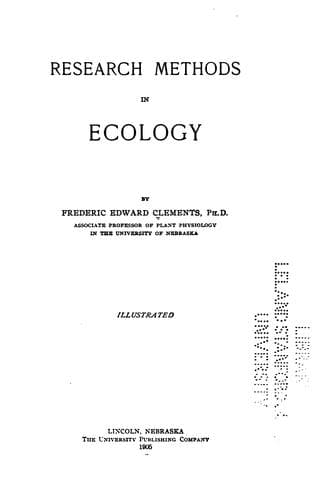
Research methods in ecologyClements, Frederic E. (Frederic Edward)
Science
Research methods in ecology
Clements, Frederic E. (Frederic Edward)
Plant ecology; Plant ecology -- Methodology
=189. Determination of factors.= For the critical investigation of the
origin of new forms, an exact knowledge of the factors of the habitat,
both physical and biotic, is imperative. In the case of variable
species, these factors determine what variations are of advantage, and
thereby the direction in which the species can develop. They are the
agents of selection. With mutants, the factors of the habitat are
apparently neither causative nor selective, though it seems probable
that further study of mutants will show an essential connection between
mutant and factor. In any event, the persistence of a mutant in nature,
and its corresponding ability to initiate new lines of development, is
as much dependent upon the selection exerted by physical and biotic
factors as is the origin of variants. Physical factors are causative
agents in the production of ecads, as has been shown at length
elsewhere. The form and structure of the ecad are the ultimate responses
to the stimuli of light or water-content, and the quantitative
determination of the latter is accordingly of the most fundamental
importance. The measurement of factors has been treated so fully in the
preceding chapters that it is only necessary to point out that the
thorough investigation of habitats by instruments is as indispensable
for the study of experimental evolution as for that of the development
and structure of the formation. Furthermore, it is evident that a
knowledge of physical factors is as imperative for habitat and control
cultures as for the method of natural experiment. In the latter,
however, the biotic factors demand unusual attention, since pollination,
isolation, etc., are often decisive factors in origin by variation and
in the persistence of mutants.
Measurements of adjustment, i. e., functional response to the direct
factor concerned, are extremely valuable, but not altogether
indispensable to research in experimental evolution. This is due to the
fact that a knowledge of adjustment is important in tracing the origin
of new forms only when adjustment is followed by adaptation, and in all
such cases the ratio between the two processes seems to be more or less
constant. In the present rudimentary development of the subject,
however, it is very desirable to make use of all methods of measuring
functional responses to water and light that are practicable in the
field. Certain methods that are difficult of application in nature may
be used to advantage in control cultures, and the results thus secured
can be used to interpret those obtained from natural experiments and
field cultures.
Public-domain text, read in full here on John Shaqi.
Reviews
Reviews
No reviews yet
Be the first to share your thoughts on this work.
Elsewhere in the archive
Join the Discussion
Join the discussion
Sign in to leave a comment or review.
Sign InorCreate an account