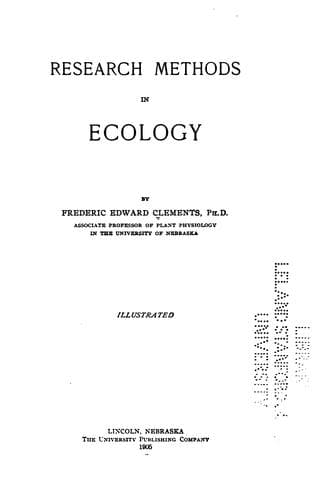
Research methods in ecologyClements, Frederic E. (Frederic Edward)
Science
Research methods in ecology
Clements, Frederic E. (Frederic Edward)
Plant ecology; Plant ecology -- Methodology
the distance for the foreground, and the focus is made upon the center.
After focusing, the shutter is closed, the indicator set at the time
desired, and the diaphragm “stopped down” as far as possible.
Plate-holder 1 is slipped into place, care being taken not to move the
camera by a sudden jar. The camera cloth is dropped above the holder and
allowed to hang down over the slide end. The slide is drawn and put on
top of the instrument, the black edge always up. The exposure is made
and the slide replaced _with the black edge outward_. This point should
receive the most critical attention, as a blunder here will often cause
the loss of two negatives. The plate-holder is returned to the
receptacle, or merely placed in the back of the camera, which is then
closed. The number of the plate, the name of the view or object, the
condition of the light, the length of exposure, and the aperture of the
diaphragm, as well as the date, are recorded in a notebook for this
purpose. The shutter is then opened at “time,” the diaphragm thrown wide
open, and the front of the camera closed. When distances are short, the
camera is often carried upon the tripod. As a rule, however, it is
usually removed, and the tripod folded. In making subsequent pictures,
the plates should always be used in their numerical order.
=240. The time of exposure= is obviously the most critical task in the
manipulation of a camera. The time necessary for a proper exposure
varies with the season, the hour, the condition of the sky, the light
intensity of the formation, the color and size of the area to be
photographed, and, finally, of course, with the aperture of the
diaphragm. Fortunately for the ecologist, the variation in light
intensity during the season, and even during the greater part of the
day, is not great, and can ordinarily be ignored. The beginner will make
the most progress by determining the exposure demanded by his instrument
for taking a general view in full sunlight and with the smallest stop of
the diaphragm. In standard cameras with lenses of ordinary rapidity,
this is usually about one second. This will serve as a basis from which
all other exposures may be reckoned until one has worked through a wide
range of conditions and can recall just what time each view requires. On
completely cloudy days the time required is five to ten times that
necessary on a clear day; filmy clouds and haze necessitate an exposure
of two or three seconds. The more open forest formations demand an
exposure of about five to ten seconds on a sunny day, while the deeper
ones require two or three times as long. A close view requires more time
than a distant one, since the light-reflecting surface is much smaller.
Quadrats require two or three seconds, and individual groups frequently
take a longer time. The color of the vegetation plays an important part
also: a dark green spruce forest requires twice as long an exposure as
the aspen forest, and a grassland quadrat takes more time than one
Public-domain text, read in full here on John Shaqi.
Reviews
Reviews
No reviews yet
Be the first to share your thoughts on this work.
Elsewhere in the archive
Join the Discussion
Join the discussion
Sign in to leave a comment or review.
Sign InorCreate an account