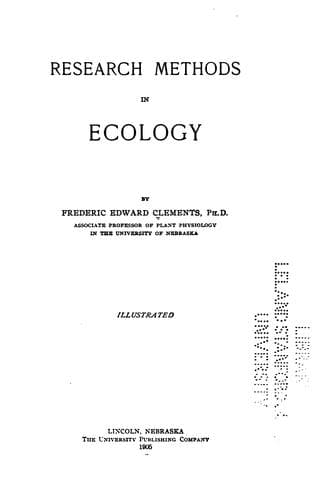
Research methods in ecologyClements, Frederic E. (Frederic Edward)
Science
Research methods in ecology
Clements, Frederic E. (Frederic Edward)
Plant ecology; Plant ecology -- Methodology
For these reasons, an accurate and complete formational record
that can be consulted or studied at any time is almost indispensable to
class study in the development and structure of formations.
=244. Details of collecting.= Formational collections, unlike the
ordinary sets of exsiccati, can not be made upon the first visit to a
region, or by a single journey through it. The determination of
formation limits, and of developmental stages, of aspects, layers,
abundance, etc., must necessarily precede, a work which alone takes
several years. Moreover, collecting itself requires more than one year
in a region containing numerous formations. This is exemplified by the
_Herbaria Formationum Coloradensium_.[23] The preliminary study for this
was made from 1896–1899, the collecting was done chiefly in 1900 and
1901, while additional numbers were added in 1902–3. For the purposes of
the formation herbarium, specimens should be collected and pressed in
such fashion as to show all the ecological features possible. Plants
must be collected both in flower and in fruit, with the underground
parts as perfect as may be. Seedlings and rosettes should be included
whenever present. In pressing, one or two leaves should be arranged with
the lower side uppermost to admit of the ready comparison of both
surfaces. Opened flowers are valuable for flower biology, while seeds
and fruits are desirable for showing migration contrivances. The ferns,
mosses, and lichens of the formation should be fully represented,
together with the more important fungi and algae. The number of
photographs taken for each herbarium should be limited only by
considerations of time and expense. The ideal series consists of a
general view of each formation, showing its physiographic setting,
nearer views of each of its aspects, detail views of its consocies,
societies, and layers, and flower portraits of all the constituent
species. Such a series can only be obtained by residence through a long
term of years, and in most cases general and aspect views, with
portraits of the facies and a few of the striking principal species,
must suffice. Quadrat and transect charts, together with formational
maps, are extremely desirable, and, indeed, all but indispensable.
Public-domain text, read in full here on John Shaqi.
Reviews
Reviews
No reviews yet
Be the first to share your thoughts on this work.
Elsewhere in the archive
Join the Discussion
Join the discussion
Sign in to leave a comment or review.
Sign InorCreate an account