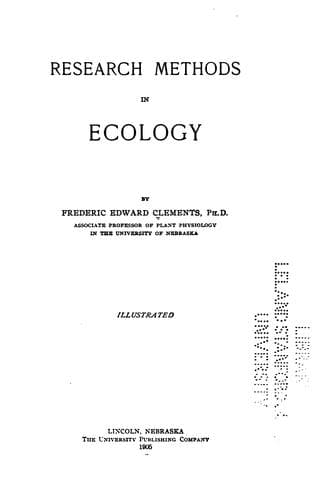
Research methods in ecologyClements, Frederic E. (Frederic Edward)
Science
Research methods in ecology
Clements, Frederic E. (Frederic Edward)
Plant ecology; Plant ecology -- Methodology
=249. Functions and structures.= The functions of a formation are
association, invasion, and succession: the second may be resolved into
migration and ecesis, and the third, perhaps, into reaction and
competition. Formational structures comprise zones, layers, consocies,
societies, etc., all of which may be referred to zonation, or to
alternation. The term association has been used in both an active and a
passive sense. In the former, it applies to the inevitable grouping
together of plants, by means of reproduction and immobility. Passively,
it refers to the actual groupings which result in this way, and in this
sense it is practically synonymous with vegetation. Invasion is the
function of movement, and of occupying or taking possession; with
association, it constitutes the two fundamental activities of
vegetation. It is the essential part of succession, but the latter is so
distinctive, because of the intimate relation of competition and
reaction, that clearness is gained by treating it as a separate function
which is especially concerned with development. Association, zonation,
and alternation are structural phenomena, which are in large part the
immediate product of habitat and function, and in a considerable degree,
also, the result of ancestral or historical facts. It is a difficult
matter to determine in what measure the last factor enters, but it is
one that must always be taken into account, particularly when the
physical factors of the habitat are inadequate to explain the structures
observed. Structurally, association regularly includes both zonation and
alternation. As there are certain typical instances in which it exhibits
neither, the treatment will be clearer if each is considered separately.
ASSOCIATION
=250. Concept.= The principle of association is the fundamental law of
vegetation. Indeed, association is vegetation, for the individual passes
into vegetation, strictly speaking, at the moment when other individuals
of the same kind or of different kinds become grouped with it. It is
then (and the same statement necessarily holds for vegetation) the
coming together and the staying together of individuals and, ultimately,
of species. A concrete instance will illustrate this fact. In the
development of the blowout formation of the Nebraska sand-hills
(_Redfieldia-Muhlenbergia-anemium_), association begins only when the
first plant of _Redfieldia flexuosa_ is joined by other plants that have
sprung from it, or have wandered in over the margin of the blowout.
Henceforth, whatever changes the blowout formation may undergo,
association is a settled characteristic of it until some new and
overwhelming physical catastrophe shall destroy the associated
individuals. It will readily be seen that association does not depend
upon particular individuals, for these pass and others take their place,
but that it does depend essentially upon number of individuals.
Public-domain text, read in full here on John Shaqi.
Reviews
Reviews
No reviews yet
Be the first to share your thoughts on this work.
Elsewhere in the archive
Join the Discussion
Join the discussion
Sign in to leave a comment or review.
Sign InorCreate an account