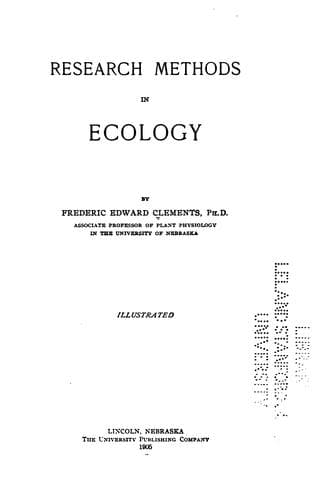
Research methods in ecologyClements, Frederic E. (Frederic Edward)
Science
Research methods in ecology
Clements, Frederic E. (Frederic Edward)
Plant ecology; Plant ecology -- Methodology
Of these, five belong to the same succession, and it is
possible to indicate the development of the spruce-pine forest by
arranging these five formations in their proper order in a succession
herbarium, as follows: (1) the gravel slide formation, (2) the half
gravel slide formation, (3) the pine formation, (4) the balsam-spruce
formation, (5) the spruce-pine formation.
DEVELOPMENT AND STRUCTURE
=247. Vegetation an organism.= The plant formation is an organic unit.
It exhibits activities or changes which result in development,
structure, and reproduction. These changes are progressive, or periodic,
and, in some degree, rhythmic, and there can be no objection to
regarding them as functions of vegetation. According to this point of
view, the formation is a complex organism, which possesses functions and
structure, and passes through a cycle of development similar to that of
the plant. This concept may seem strange at first, owing to the fact
that the common understanding of function and structure is based upon
the individual plant alone. Since the formation, like the plant, is
subject to changes caused by the habitat, and since these changes are
recorded in its structure, it is evident that the terms, function and
structure, are as applicable to the one as to the other. It is merely
necessary to bear in mind that the functions of plants and of formations
are absolutely different activities, which have no more in common than
do the two structures, leaf and zone.
=248. Vegetation essentially dynamic.= As an organism, the formation is
undergoing constant change. Constructive or destructive forces are
necessarily at work; the former, as in the plant, predominate until
maturity, when the latter prevail. Consequently, it no longer seems
fruitful to classify the phenomena of vegetation as dynamic or static.
The emphasis which has been placed upon dynamic aspects of vegetation
has served a useful purpose by calling attention to the development of
the latter. Although it is a quarter of a century since Hult, and more
than a half century since Steenstrup, by far the greater number of
ecological studies still ignore the problem of development. This
condition, however, can be remedied more easily by insisting upon an
exact understanding of the nature of the formation than in any other
way. It is entirely superfluous to speak of dynamic and static effects
in the plant, and the use of these terms with reference to the formation
becomes equally unnecessary as soon as the latter is looked upon as an
organism. The proper investigation of a formation can no more overlook
development than structure, so closely are the two interwoven. Future
research must rest squarely upon this fact.
Public-domain text, read in full here on John Shaqi.
Reviews
Reviews
No reviews yet
Be the first to share your thoughts on this work.
Elsewhere in the archive
Join the Discussion
Join the discussion
Sign in to leave a comment or review.
Sign InorCreate an account