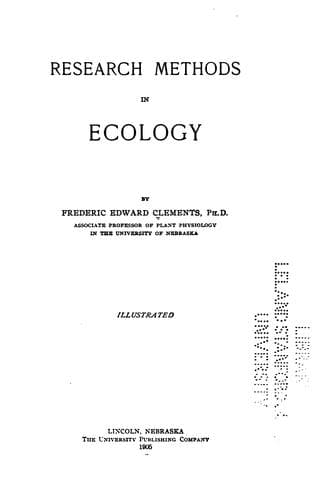
Research methods in ecologyClements, Frederic E. (Frederic Edward)
Science
Research methods in ecology
Clements, Frederic E. (Frederic Edward)
Plant ecology; Plant ecology -- Methodology
=252. Aggregation.= As indicated under the causes of association, the
process by which groups of individuals are formed depends entirely upon
reproduction and migration. In short, aggregation is merely a corollary
of movement. The simplest example of this process occurs in forms like
_Gloeocapsa_, _Tetraspora_, and others, where the plants resulting from
fission are held together by means of a sheath. Though called a colony,
such a group of individuals is a family in the ordinary sense.
Practically the same grouping results in the case of terrestrial plants,
especially spermatophytes, when the seeds of a plant mature and fall to
the ground about it. The relation in both instances is essentially that
of parent and offspring, although the parent soon disappears in the case
of annuals, while among the algae its existence is regularly terminated
by fission. The size and the density of the family group are determined
by the number of seeds produced, and by their mobility. These are
further affected by the height and branching of the plant, and by the
position of the seeds upon it. The disseminules of immobile species fall
directly beneath the parent, and the resulting group is both uniform and
definite. A similar arrangement is caused likewise by offshoots. An
increase in mobility brings about a decrease of aggregation, since the
disseminules are carried away from the parent plant. Perfectly mobile
forms rarely produce family groups for this reason. It is evident,
however, that mobile perennials sometimes arrange themselves in similar
fashion in consequence of propagation by underground parts.
Consequently, it is possible to state the law of single aggregation,
viz., that immobility promotes the grouping of parent and offspring, and
mobility hinders it.
Public-domain text, read in full here on John Shaqi.
Reviews
Reviews
No reviews yet
Be the first to share your thoughts on this work.
Elsewhere in the archive
Join the Discussion
Join the discussion
Sign in to leave a comment or review.
Sign InorCreate an account