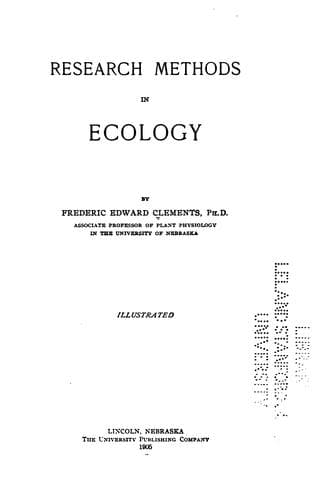
Research methods in ecologyClements, Frederic E. (Frederic Edward)
Science
Research methods in ecology
Clements, Frederic E. (Frederic Edward)
Plant ecology; Plant ecology -- Methodology
If all species were immobile, the family group would be characteristic
of vegetation. Since the great majority are more or less mobile,
aggregates of this sort are the exception rather than the rule. Mobility
not only decreases the number of offspring in the family group, but it
also spreads disseminules broadcast to enter dissimilar groups. It leads
directly to mixed aggregation, by which individuals of one or more
species invade the family group. Once established, the newcomers tend
also to produce simple groups, thus causing an arrangement corresponding
essentially to a community. Such collections of family groups are
extremely variable in size and definition. This arises in part from the
nature of simple aggregation, and in part from the varying mobility of
different species. Mobility alone often produces similar communities by
bringing together the disseminules of different plants, each of which
then becomes the center of a mixed group. In the case of permobile
species, several disseminules of each may be brought together. The
resulting area, though larger, is practically the same. At present, it
is difficult to formulate the law for this method of grouping. It may be
stated provisionally as follows: mixed aggregation is the direct result
of mobility, and the greater the mobility the more heterogeneous the
mixture.
The constitution of all the major areas of a formation is to be
explained upon the basis of aggregation by the two methods described.
The relative importance of family groups and communities differs for
every formation, and the exact procedure in each can be obtained only by
the detailed study of quadrats. The problem is further complicated by
competition and reaction, particularly in closed vegetation. For this
reason, aggregation can be studied most satisfactorily in a new or
denuded area, where these processes are not yet in evidence.
_Kinds of Association_
=253. Categories.= In the analysis of association, it must be kept
clearly in mind that the concrete examples from which all
generalizations must be drawn are often in very different stages of
development, and are of correspondingly different ages. For this reason
it has seemed best to consider the primary relations of association in
general in this place, leaving the treatment of the effects of invasion,
succession, alternation, and zonation to be taken up under these topics.
Public-domain text, read in full here on John Shaqi.
Reviews
Reviews
No reviews yet
Be the first to share your thoughts on this work.
Elsewhere in the archive
Join the Discussion
Join the discussion
Sign in to leave a comment or review.
Sign InorCreate an account