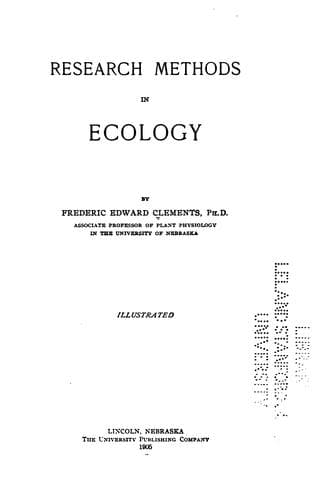
Research methods in ecologyClements, Frederic E. (Frederic Edward)
Science
Research methods in ecology
Clements, Frederic E. (Frederic Edward)
Plant ecology; Plant ecology -- Methodology
=256. Species guild association.= Drude has distinguished a kind
of association peculiar to invasion, in which there is a
successive or concomitant movement of certain species of a
formation into another formation or region, resulting in species
guilds (_Artengenossenschaften_). The association in this case is
largely one of community of origin or area, and of concomitant
migration. It is especially characteristic of areas adjacent to
formational and regional limits. Fundamentally, it is merely the
grouping of plants which are invading at the same time, and
consequently it differs only in degree from what occurs in every
invasion where more than a single individual is concerned.
Accordingly, this type of association has little more than
historical interest. This must not be construed to mean that it
does not occur, but that it differs in no essential from the
ordinary grouping of invaders.
=257. Light association.= The constituent species of formations show two
fundamentally different groupings with respect to light. In the one
case, the individuals are on the same level, or nearly so, in such a way
that each has direct access to sunlight. Such an arrangement is
characteristic of most grassland and herbaceous formations. In the case
of desert formations, there is often considerable difference in the
height of the plants, but the distance between them is so great as to
admit of direct illumination of all. This arrangement may be termed
coordinate association. In forests, thickets, and many herbaceous
wastes, the height and density of certain species enable them to
dominate the formation. In a dense forest, the trees receive practically
all the light incident upon the formation, and the shrubs, herbs, fungi,
and algae of lower habit and inferior position must adapt themselves to
the diffuse light which passes through or between the leaves. The same
is equally true of dense thickets and wastes, except that the vertical
distance is less, and the diffuseness of the light is correspondingly
modified. In these formations, the dominant trees, shrubs, or herbs, the
facies, constitute a primary or superior layer. The degree of
subordinate association, as a result of which inferior layers will
arise, is entirely determined by the density of the facies. In open
woodlands, which are really mixed formations of woodland and grassland,
the intervals, and usually the spaces beneath the trees also, are
covered with poophytes, showing an absence of subordination due to
light. This is the prevailing condition in the pine formation (_Pinus
ponderosa-xerohylium_) of the ridges and foot-hills of western Nebraska.
When, however, the trees stand sufficiently close that their shadows
meet or overlap throughout the day, the increasing diffuseness begins to
cause modification and rearrangement of the individuals. By photometric
methods, the light in a forest is found to be least diffuse just below
the facies, while the diffuseness increases markedly in passing to the
Public-domain text, read in full here on John Shaqi.
Reviews
Reviews
No reviews yet
Be the first to share your thoughts on this work.
Elsewhere in the archive
Join the Discussion
Join the discussion
Sign in to leave a comment or review.
Sign InorCreate an account