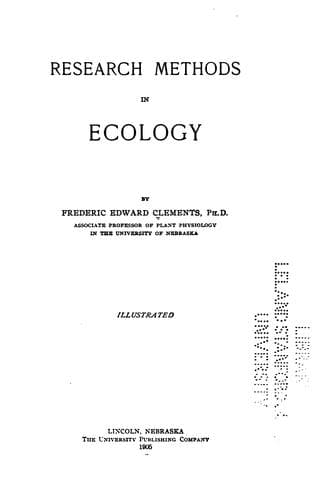
Research methods in ecologyClements, Frederic E. (Frederic Edward)
Science
Research methods in ecology
Clements, Frederic E. (Frederic Edward)
Plant ecology; Plant ecology -- Methodology
He terms these plant societies
(_Genossenschaften_), retaining the four groups already established,
lianae, epiphyta, saprophyta, and parasiticae. It is evident that
dependent association comprises extremely divergent forms, from the
slightly clinging herb, such as _Galium_, to the most intense parasite.
The distinction, however, is a clear one, if restricted to that relation
between plants in which one acts as a mechanical support or stratum or
as a nutritive host for the other.
=255. Ground association.= The first division of formations into open
and closed was made by Engler and Drude.[27] Open formations were
defined as those having incomplete stability and heterogeneous
composition, while closed formations have a more definite uniform stamp.
What is true of formations is equally true of vegetation, so that
association may be regarded as open or closed with reference to the
density and thoroughness with which the plants occupy the ground. In
open association, the ground is slightly or partially occupied, readily
permitting the entrance of new plants without the displacement of those
already present. Such an arrangement is characteristic of the early
stages of a formation, or of a succession of formations. It produces
unstable open formations, which arise, usually after denudation, in
sand-hills, blowouts, gravel slides, dunes, flood plains, burned areas,
etc. In closed association, occupation of the ground is complete, and
the invasion of new species can occur only through displacement. Closed
association results in stable, closed formations, such as forest,
thicket, meadow, and prairie. As open association characterizes the
early stages of a succession of formations, so closed association is
peculiar to the later or last stages of all such successions. In short,
open formations represent certain phases of the development of
vegetation, while closed formations correspond to the relatively final
structural conditions. It is a fundamental principle of association that
every succession from denudation, or from newly formed soils, begins
with open formations and ends with a closed formation. The causes
leading up to open and closed association are intimately connected with
development, and hence are considered under invasion and succession.
Public-domain text, read in full here on John Shaqi.
Reviews
Reviews
No reviews yet
Be the first to share your thoughts on this work.
Elsewhere in the archive
Join the Discussion
Join the discussion
Sign in to leave a comment or review.
Sign InorCreate an account