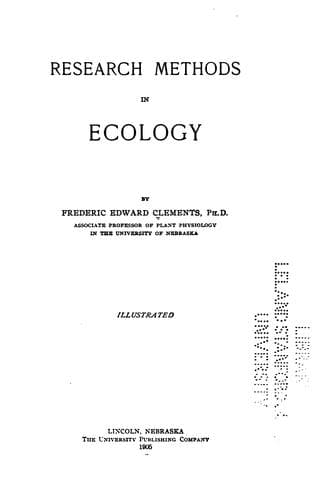
Research methods in ecologyClements, Frederic E. (Frederic Edward)
Science
Research methods in ecology
Clements, Frederic E. (Frederic Edward)
Plant ecology; Plant ecology -- Methodology
=264. Contrivances for dissemination.= Any investigation of migration to
be exact must confine itself to fixed forms. For these the degree of
perfection shown by dissemination contrivances corresponds almost
exactly to the degree of mobility. Because of the difficulty of
ascertaining the effect of ecesis, it is impossible to determine the
actual effectiveness in nature of different modifications, and the best
that can be done at present is to regard mobility, together with the
occurrence and forcefulness of distributive agents, as an approximate
measure of migration. The general accuracy of such a measure will be
more or less evident from the following. Of 118 species common to the
foot-hill and sand-hill regions of Nebraska, regions which are
sufficiently diverse to indicate that these common species must have
entered either one by migration from the other, 83 exhibit modifications
for dissemination, while 8 others, though without special contrivances,
are readily distributed by water, and 4 more are mobile because of
minuteness of spore or seed. Some degree of mobility is present in 73
per cent of the species common to these regions, while of the total
number of species in which the mode of migration is evident, viz., 95,
66 per cent are wind-distributed, 20 per cent animal-distributed, and 14
per cent are water-distributed. It need hardly be noted that this
accords fully with the prevalence and forcefulness of winds in these
regions. Of the species peculiar to the foot-hill region, many are
doubtless indigenous, though a majority have come from the montane
regions to the westward. The number of mobile species is 121, or 60 per
cent of the entire number, while the number of wind-distributed ones is
85, or 70 per cent of those that are mobile. Among the 25 species found
in the widely separated wooded bluff and foot-hill regions, 2 only,
_Amorpha nana_ and _Roripa nasturtium_, are relatively immobile, but the
minute seeds of the latter, however, are readily distributed, and the
former is altogether infrequent.
The following groups of plants may be distinguished according to the
character of the contrivance by which dissemination is secured:
1. Saccate, saccospores. Here are to be placed a variety of fruits, all
of which agree, however, in having a membranous envelope or an
impervious, air-containing pericarp. In _Ostrya_, _Physalis_,
_Staphylea_, the modification is for wind-distribution, while in
_Carex_, _Nymphaea_, etc., it is for water-transport.
2. Winged, pterospores. This group includes all winged, margined, and
flattened fruits and seeds, such as are found in _Acer_, _Betula_,
_Rumex_, many _Umbelliferae_, _Graminaceae_, etc.
3. Comate, comospores. To this group belong those fruits and seeds with
long silky hairs, _Gossypium_, _Anemone_, _Asclepias_, etc., and those
with straight capillary hairs or bristles not confined to one end,
_Typha_, _Salix_, etc.
Public-domain text, read in full here on John Shaqi.
Reviews
Reviews
No reviews yet
Be the first to share your thoughts on this work.
Elsewhere in the archive
Join the Discussion
Join the discussion
Sign in to leave a comment or review.
Sign InorCreate an account