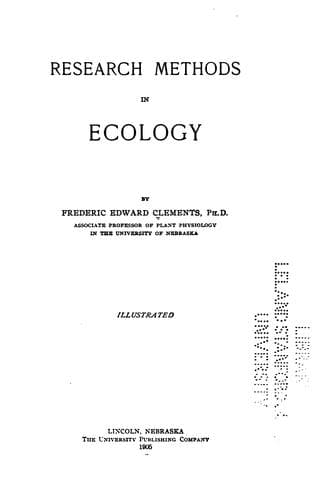
Research methods in ecologyClements, Frederic E. (Frederic Edward)
Science
Research methods in ecology
Clements, Frederic E. (Frederic Edward)
Plant ecology; Plant ecology -- Methodology
2. Wind, anemochores. This group includes the majority of all permobile
terrestrial plants, i. e., those in which modifications for increasing
surface have been carried to the extreme, or those which are already
permobile by reason of the minuteness of the spore or seed. Saccate,
winged, comate, parachute, pappose, plumed, and, to a certain extent,
awned seeds and fruits represent the various types of modifications for
wind-distribution.
3. Animals, zoochores. Among terrestrial plants, dissemination by
attachment represents essentially the same degree of specialization as
is found in wind-distributed plants. The three types of contrivances for
this purpose are found in spinose, hooked, and glandular fruits.
Dissemination by deglutition and by carriage, either intentional or
unintentional, though of less value, play a striking part on account of
the great distance to which the seeds may be carried. Dissemination by
deglutition is characteristic of sarcospores, and distribution by
carriage of creatospores.
4. Man, brotochores. Dissemination by man has practically no connection
with mobility. It operates through great distances and over immense
areas as well as near at hand. It may be intentional, as in the case of
cultivated species, or unintentional, as in thousands of native or
exotic species. No other disseminating agent is comparable with man in
respect to universal and obvious migration.
5. Gravity, clitochores. The members of this group are exclusively
colline, montane, and alpine plants, growing on rocks, cliffs, and
gravel slides (talus), etc., in which the seeds reach lower positions
merely by falling, or more frequently by the breaking away and rolling
down of rock or soil masses and particles. Dissemination by this method
is relatively insignificant, though it plays an important part in the
rock fields and gravel slides of mountain regions, particularly in the
case of immobile species.
6. Glaciers, crystallochores. At the present time, transport by glaciers
is of slight importance, because of the restriction of the latter to
alpine and polar regions, where the flora is poorly developed. In the
consideration of migrations during the glacial epoch, however, it plays
an important point.
7. Growth, blastochores. The mobility of species disseminated by
offshoots is extremely slight, and the annual movement relatively
insignificant. The certainty of migration and of ecesis, is, however, so
great, and the presence of offshoots so generally the rule in
terrestrial plants that growth plays an important part in migration,
especially within formations.
Public-domain text, read in full here on John Shaqi.
Reviews
Reviews
No reviews yet
Be the first to share your thoughts on this work.
Elsewhere in the archive
Join the Discussion
Join the discussion
Sign in to leave a comment or review.
Sign InorCreate an account