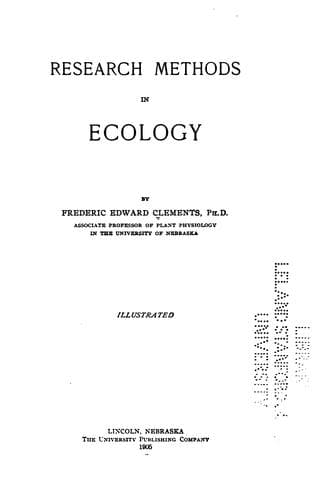
Research methods in ecologyClements, Frederic E. (Frederic Edward)
Science
Research methods in ecology
Clements, Frederic E. (Frederic Edward)
Plant ecology; Plant ecology -- Methodology
=268. The direction of migration= is determinate, except in the case of
those distributive agents which act constantly in the same direction.
The general tendency is, of course, forward, the lines of movement
radiating in all directions from the parent area. This is well
illustrated by the operation of winds which blow from any quarter. In
the case of the constant winds, migration takes a more or less definite
direction, the latter being determined to a large degree by the fruiting
period of any particular species. In this connection, it must be kept
clearly in mind that the position of new areas with reference to the
original home of a species does not necessarily indicate the direction
of migration, as the disseminules may have been carried to numerous
other places in which ecesis was impossible. The local distribution of
zoochorous species is of necessity indeterminate, though distant
migration follows the pathways of migratory birds and animals. In so far
as dissemination by man takes place along great commercial routes, or
along highways, it is determinate. In ponds, lakes, and other bodies of
standing water, migration may occur in all directions, but in ocean
currents, streams, etc., the movement is determinate, except in the case
of motile species. The dissemination of plants by slopes, glaciers,
etc., is local and definite, while propulsion is in the highest degree
indeterminate. Migration by growth is equally indefinite, with the
exception that hydrotropism and chemotropism result in a radiate
movement away from the mass, while propulsion throws seeds indifferently
into or away from the species-mass. From the above it will be seen that
distant migration may take place by means of water, wind, animals or
man, and, since all these agents act in a more or less definite
direction over great distances, that it will be in some degree
determinate. On the other hand, local migration will as regularly be
indeterminate, except in the case of streams and slopes. The direction
of migration, then, is controlled by these distributive agents, and the
limit of migration is determined by the intensity and duration of the
agent, as well as by the character of the space through which the latter
operates.
_ECESIS_
=269. Concept.= By the term ecesis is designated the series of phenomena
exhibited by an invading disseminule from the time it enters a new
formation until it becomes thoroughly established there. In a word,
ecesis is the adjustment of a plant to a new habitat. It comprises the
whole process covered more or less incompletely by acclimatization,
naturalization, accommodation, etc. It is the decisive factor in
invasion, inasmuch as migration is entirely ineffective without it, and
is of great value in indicating the presence and direction of migration
in a great number of species where the disseminule is too minute to be
detected or too little specialized to be recognizable.
Public-domain text, read in full here on John Shaqi.
Reviews
Reviews
No reviews yet
Be the first to share your thoughts on this work.
Elsewhere in the archive
Join the Discussion
Join the discussion
Sign in to leave a comment or review.
Sign InorCreate an account