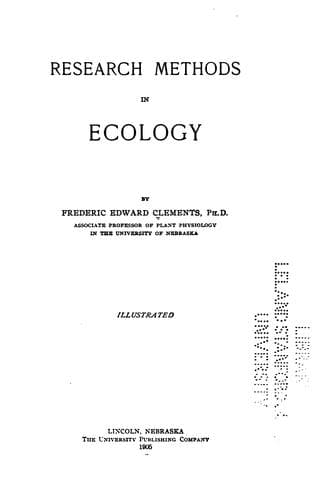
Research methods in ecologyClements, Frederic E. (Frederic Edward)
Science
Research methods in ecology
Clements, Frederic E. (Frederic Edward)
Plant ecology; Plant ecology -- Methodology
The relation of migration to ecesis is a most intimate one: the latter
depends in a large measure upon the time, direction, rapidity, distance,
and amount of migration. In addition, there is an essential alternation
between the two, inasmuch as migration is followed by ecesis, and the
latter then establishes a new center from which further migration is
possible, and so on. The time of year in which fruits mature and
distributive agents act has a marked influence upon the establishment of
a species. Disseminules designed to pass through a resting period are
often brought into conditions where they germinate at once, and in which
they perish because of unfavorable physical factors, or because
competing species are too far advanced. On the other hand, spores and
propagules designed for immediate germination may be scattered abroad at
a time when conditions make growth impossible. The direction of movement
is decisive in that the seed or spore is carried into a habitat
sufficiently like that of the parent to secure establishment, or into
one so dissimilar that germination is impossible, or at least is not
followed by growth and reproduction. The rapidity and distance of
migration have little influence, except upon the less resistant
disseminules, conidia, gemmae, etc. Finally, the amount of migration, i.
e., the number of migrants, is of the very greatest importance,
affecting directly the chances that vigorous disseminules will be
carried into places where ecesis is possible.
Normally, ecesis consists of three essential processes, germination,
growth, and reproduction. This is the rule among terrestrial plants, in
which migration regularly takes place by means of a resting part. In
free aquatic forms, however, the growing plant or part is usually
disseminated, and ecesis consists merely in being able to continue
growth and to insure reproduction. Here establishment is practically
certain, on account of the slight differences in aquatic habitats,
excepting of course the extremes, fresh water and salt water. The ease
indeed with which migration and ecesis are effected in the water often
makes it impossible to speak properly of invasion in this connection,
since aquatics are to such a large extent cosmopolitan. In dissemination
by offshoots, the conditions are somewhat similar. Here, also, ecesis
comprises the sequence of growth and reproduction, and invasion, in the
sense of passing from one habitat to another, is of rare occurrence, as
the offshoot grows regularly under the same conditions as the parent
plant. The adjustment of growing plants and parts is so slight, and
their establishment so certain on account of their inability to migrate
into very remote or different habitats, that they may be ignored in the
following discussion.
Public-domain text, read in full here on John Shaqi.
Reviews
Reviews
No reviews yet
Be the first to share your thoughts on this work.
Elsewhere in the archive
Join the Discussion
Join the discussion
Sign in to leave a comment or review.
Sign InorCreate an account