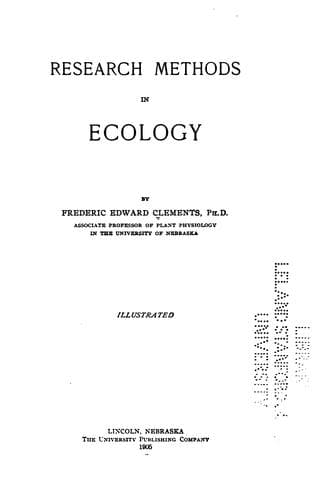
Research methods in ecologyClements, Frederic E. (Frederic Edward)
Science
Research methods in ecology
Clements, Frederic E. (Frederic Edward)
Plant ecology; Plant ecology -- Methodology
=284. Permanent and temporary invasion.= The permanence of invasion
depends upon the success attending ecesis, and upon the stability of the
formation. It has already been noticed that under certain conditions
plants may germinate and grow, and if they are perennials, even become
established, and still ecesis be so imperfect that reproduction is
impossible. Others may find the conditions sufficiently favorable for
propagation, but unfavorable for the formation of flowers and fruits.
Finally there are plants which seem to be perfectly established for a
few years, only to disappear completely. The latter are examples of
_temporary invasion_. It is necessary to draw clearly the line between
complete and partial invasion in this connection. The former is
temporary in the initial or intermediate stages of nearly all
successions, as compared with the ultimate stages, though it is in a
large degree permanent in comparison with the partial invasion of
species which are able to maintain themselves for a few years. In a
sense, there is a real distinction between the two, inasmuch as a
particular stage of succession is permanent as long as the habitat
remains essentially the same. A critical study of the species of such
stages shows, however, that they manifest very different degrees of
permanence. Species which invade stable vegetation temporarily have been
termed _adventive_ by A. DeCandolle. _Permanent invasion_ occurs when a
species becomes permanently established in a more or less stable
formation. It is characteristic of the great majority of invaders found
in the grassland and forest stages of successions.
Plants which have arisen within a formation or have been a constituent
part of it since its origin are _indigenous_. Contrasted with these are
the species which have invaded the formation since it received its
distinctive impress: these are _derived_. The determination of the
indigenous and derived species of a formation or larger division is of
the utmost importance, as it enables us to retrace the steps by which
the formation has reached its present structure, and to reconstruct
formations long since disappeared. To render it less difficult, it is
necessary to scrutinize the derived elements closely, first, because it
is easiest to recognize the indigenous species by eliminating the
derived, and second, because this analysis will show that not all
derived species have entered the formation at the same time and from the
same sources. Derived species may be termed _vicine_, when they are
fully established invaders from adjacent formations or regions, and
_adventitious_, when they have come from distant formations and have
succeeded in establishing themselves. Finally, those derived species
which are unable to establish themselves permanently are _adventive_.
_MANNER OF INVASION_
Public-domain text, read in full here on John Shaqi.
Reviews
Reviews
No reviews yet
Be the first to share your thoughts on this work.
Elsewhere in the archive
Join the Discussion
Join the discussion
Sign in to leave a comment or review.
Sign InorCreate an account