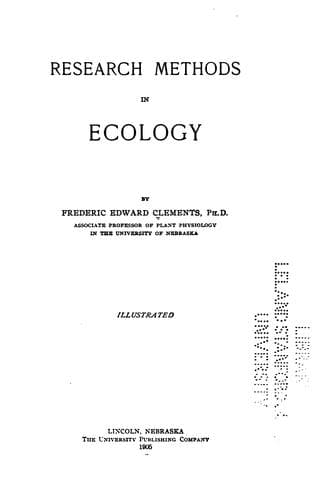
Research methods in ecologyClements, Frederic E. (Frederic Edward)
Science
Research methods in ecology
Clements, Frederic E. (Frederic Edward)
Plant ecology; Plant ecology -- Methodology
soils proper to be comparable with alluvial soils.
[Illustration: Fig. 62. Talus arising from the decomposition of granite;
the gravel is covered with a formation of foliose lichens
(_Parmelia-chalicium_), the second stage of the primary talus
succession; the herbs are pioneers of the next stage.]
=297. Succession in aeolian soils.= The only wind-borne soils of
geological importance at the present time are those which form dunes,
both inland and coastal. Aeolian deposits consist largely of rounded
sand particles, which are of almost uniform size in any particular dune,
but vary greatly in dunes of different ages. The reaction of the
pioneers on dunes plays an important part in building the latter, but
the immense dunes of inland deserts, which are entirely destitute of
vegetation, seem to indicate that its value has been overestimated. The
first stages in dune successions are dissophytic, i. e., the plants grow
in a soil of medium or high water-content, but in an atmosphere that is
extremely xerophytic. The ultimate stages vary widely in accordance with
the region in which they occur; they may be xerophytic heaths or
mesophytic meadows and forests. Because of their striking character and
economic significance, dunes have received much attention, with the
result that their successions are the most thoroughly known of all.
Prairie and steppe formations are probably to be regarded as the
ultimate stages of successions established on wind-borne loess, and it
is possible that the same is true of sand-hill vegetation in the prairie
province.
=298. Succession in glacial soils.= The formation of glacial deposits is
at present confined to alpine and arctic regions. Recent successions in
such soils are localized in these regions, and are in consequence
relatively unimportant. There can be little question, however, that the
thorough investigation of succession in and near the moraines of
existing glaciers will throw much light upon the successions of the
glacial period. Moraines, drumlins, eskars, and alluvial cones represent
the various kinds of glacial deposits. They agree in being heterogeneous
in composition, and are covered to-day with ultimate stages of
vegetation, except in the immediate vicinity of glaciers.
_SECONDARY SUCCESSIONS_
Public-domain text, read in full here on John Shaqi.
Reviews
Reviews
No reviews yet
Be the first to share your thoughts on this work.
Elsewhere in the archive
Join the Discussion
Join the discussion
Sign in to leave a comment or review.
Sign InorCreate an account