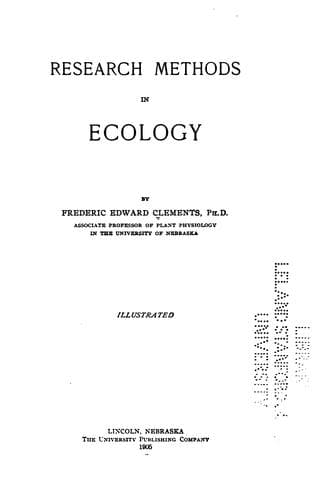
Research methods in ecologyClements, Frederic E. (Frederic Edward)
Science
Research methods in ecology
Clements, Frederic E. (Frederic Edward)
Plant ecology; Plant ecology -- Methodology
In all streams that have become graded, the fall is insufficient to
carry off the surplus water in the spring when snows are melting
rapidly, or at times of unusual precipitation. These waters accumulate,
and, overflowing the banks, spread out over the lowlands, resulting in
the formation of a well-defined flood plain. This is a periodical
occurrence with mature streams, and it occurs more or less regularly
with all that are not torrent-like in character. The effect of the
overflow is to destroy or to place at a disadvantage those plants of the
flood plain that are not hydrophytes. At the same time, a thin layer of
fresh silt is deposited upon the valley floor of sand or alluvium.
Flooding is most frequent and of longest duration near the banks of the
stream. It extends more or less uniformly over the flood plain, and
disappears gradually or abruptly as the latter rises into the bench
above. Floods destroy vegetation and make a place for secondary
successions by drowning out mesophytic species, by washing away the
aquatic forms of ponds and pools, and by the erosion of banks and
sandbars. They affect the amphibious vegetation of swamp and shore to a
certain extent, but, unless the period of flooding is long, they tend to
emphasize such formations rather than to destroy them. The still-water
formations of many cutoff and oxbow lakes owe their origin to a river
which cuts across a meander in time of flood. This result is more often
attained by the alternate silting and erosion of a meandering river by
which it cuts across a bend in its channel. The usual successions in
flooded lands are short as a rule; amphibious algae, liverworts, and
mosses soon give way to ruderal plants, and these in turn to the
original mesophytes of meadows, or dissophytes of sandbars. In the case
of ponds and pools, the process of washing-out or silting up merely
removes or destroys the vegetation, without effectively modifying the
habitat, and the secondary successions that follow are extremely short.
Public-domain text, read in full here on John Shaqi.
Reviews
Reviews
No reviews yet
Be the first to share your thoughts on this work.
Elsewhere in the archive
Join the Discussion
Join the discussion
Sign in to leave a comment or review.
Sign InorCreate an account