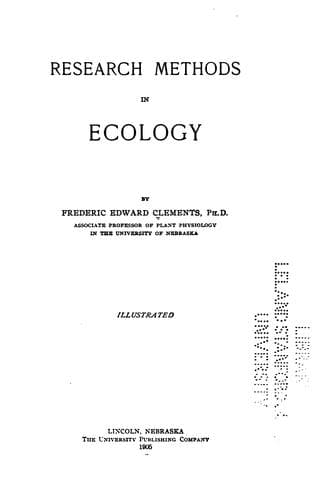
Research methods in ecologyClements, Frederic E. (Frederic Edward)
Science
Research methods in ecology
Clements, Frederic E. (Frederic Edward)
Plant ecology; Plant ecology -- Methodology
One of the greatest aids which modern ecology can furnish forestry,
however, is the method of determining the physical nature of the
habitat. So far, foresters have been obliged to content themselves with
a more or less superficial study of the structure of forest formations,
without being able to do more than guess at the physical causes which
control both structure and development. This handicap is especially
noticeable in the case of forest plantings in non-forested regions,
where it has been impossible to estimate the chances of success, or to
determine the most favorable areas except by actual plantations.
Equipped with the proper instruments for measuring water-content,
humidity, light and temperature, the ecologist is able to determine the
precise conditions under which reproduction is occurring, and to
ascertain what non-forested areas offer the most nearly similar
conditions. A knowledge of habitats and the means of measuring them
enables the forester to discover the causes which control the vegetation
with which he is already familiar, and to forecast results otherwise
hidden. Furthermore, it makes it possible for him to enter a new region
and to determine its nature and capabilities at a minimum of time and
energy.
=21. Physiography.= Physiographic features play an important part in
determining the quantity of certain direct factors of the habitat.
Perhaps a more important connection between physiography and ecology is
to be found in succession. The beginning of all primary, and of many
secondary successions is to be sought in the physiographic processes
which produce new habitats, or modify old ones. On the other hand, most
of the reactions which continue successions exert a direct influence
upon the form of the land. The most pronounced influence of terrestrial
successions is found in the stabilization which their ultimate stages
exert upon land forms, even where these are highly immature. The chief
effect of aquatic successions is to be found in the “silting up” and the
formation of new land, which result from the action of vegetation upon
silt-bearing waters. The closeness of the relation between succession
and the forms of the land has led to the application of the term
“physiographic ecology” to that part of the subject which deals with the
development of vegetation, i. e., succession.
=22. Soil physics.= This subject is as much a part of ecology as is
forestry. It is intrinsically that subdivision of ecology which deals
with the edaphic factors of the habitat, and their relation to the
plant. Since the basis is physics, there has been a general tendency to
overvalue the determination of soil properties, and to ignore the fact
that these are decisive only when considered with reference to the
living plant. As the soil contains the water which is the factor of
greatest importance to plants, soil physics is an especially important
part of ecology. Its methods are discussed under the habitat.
Public-domain text, read in full here on John Shaqi.
Reviews
Reviews
No reviews yet
Be the first to share your thoughts on this work.
Join the Discussion
Join the discussion
Sign in to leave a comment or review.
Sign InorCreate an account