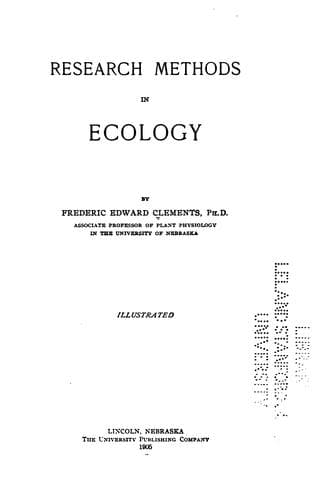
Research methods in ecologyClements, Frederic E. (Frederic Edward)
Science
Research methods in ecology
Clements, Frederic E. (Frederic Edward)
Plant ecology; Plant ecology -- Methodology
=70. The time of readings.= If simple instruments alone are used for
determining humidity, readings are practically without value unless made
simultaneously through several stations, or successively at one. When it
is possible to combine these, and to make psychrometer readings at
different habitats for each hour of the day, or at the same hour for
several days, the series is of very great value. Single readings are
unreliable on account of the hourly and daily variations of humidity,
but when these changes are recorded by a psychrograph, such readings at
once become of use, whether made in the same habitat with the recording
instrument or elsewhere. In the latter case, one reading will tell
little about the normal humidity of the habitat, but several make a
close estimate possible. When a series of psychrographs is in use,
accurate observations can be made to advantage anywhere at any time. As
a rule, however, it has been found most convenient to make simple
readings at 6:00 A.M., 1:00 P.M., and 6:00 P.M., as these hours afford
much evidence in regard to the daily range. A good time also is that at
which the temperature maximum occurs each day, but this is movable and
in the press of field work can rarely be taken advantage of. A very fair
idea of the daily mean humidity is obtainable by averaging the readings
made at the hours already indicated. The comparison of single readings
with the psychrograph record should not be made at a time when a rapid
change is occurring, as the automatic instrument does not respond
immediately. Such a condition is usually represented by a sudden rain,
and is naturally not a satisfactory time for single readings in any
event.
[Illustration: Fig. 9. Atmometer.]
=71. Place and height.= As stated above, the psychrograph is placed
three feet above the surface of the ground in making readings for the
comparison of stations. In low, herbaceous formations, the instrument is
usually placed within a few inches of the soil in order to record the
humidity of the air in which the plants are growing. In forest
formations, the moisture often varies considerably in the different
layers. This variation is easily determined by simultaneous psychrometer
readings in the several layers, or, if occasion warrants, a series of
psychrographs may be used. In field work the rule has been to make
observations with the psychrometer at 6 feet, 3 feet, and the surface of
the soil, but the reading at the height of 3 feet is ordinarily
sufficient. Humidity varies so easily that several readings in different
parts of one formation are often desirable. In comparing different
formations, the readings should be made in corresponding situations, for
example, in the densest portion of each.
Public-domain text, read in full here on John Shaqi.
Reviews
Reviews
No reviews yet
Be the first to share your thoughts on this work.
Elsewhere in the archive
Join the Discussion
Join the discussion
Sign in to leave a comment or review.
Sign InorCreate an account