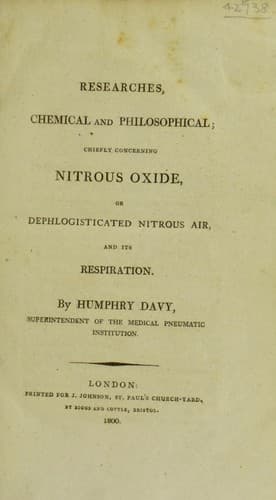
Researches Chemical and Philosophical; Chiefly concerning nitrous oxide: or dephlogisticated nitrous air and its respirationDavy, Humphry, Sir
Science
Researches Chemical and Philosophical; Chiefly concerning nitrous oxide: or dephlogisticated nitrous air and its respiration
Davy, Humphry, Sir
Nitrous oxide
The first method adopted was inflammation by means of oxygenated
muriate of potash. A small particle of oxygenated muriate of potash was
inserted into the phosphorus to be burnt. On the application of a wire,
moderately hot, to the point of insertion, the salt was decomposed by
the phosphorus, and sufficient fire generated and partially applied
by the slight explosion, to produce the combustion of the phosphorus,
without the previous sublimation of any part of it.
The second way employed was the ignition of a part of the phosphorus,
by means of the combustion of a small portion of tinder of cotton,[173]
or paper, in contact with it, by the burning glass.
[173] It will be seen hereafter that these bodies are easily inflamed
in nitrous oxide.
The third, and most successful mode, was by introducing into the
graduated jar containing the nitrous oxide, the phosphorus in a small
tube containing oxygene, so balanced as to swim on the surface of the
mercury, without communicating with the nitrous oxide. The phosphorus
was fired in the oxygene with an ignited iron wire, by which at the
moment of combustion, the tube containing it was raised into the
nitrous oxide, and thus the inflammation continued.
_d._ In different experiments, made with accuracy, I found that the
whole of a quantity of nitrous oxide was never decomposable by ignited
phosphorus; the combustion always stopped when the nitrous oxide
remaining was to the nitrogene evolved as about 1 to 5; likewise that
the volume of nitrogene produced was rather less than that of the
nitrous oxide decomposed, and that this deficiency arose from the
formation of nitrous acid by the intense ignition produced during the
process.
Of one experiment I shall give a detail.
Temperature being 48°, two cubic inches of pure nitrous oxide, which
had been generated over mercury, were introduced into a jar of the
capacity of 9 cubic inches, graduated to,1 cubic inches, and much
enlarged at the base. A grain of phosphorus was inserted into a small
vessel about one third of an inch long, and half an inch in diameter,
containing about 15 grain measures of very pure oxygene; this vessel,
which swam on the surface of the mercury, was carefully introduced
into the jar containing the nitrous oxide. The phosphorus was fired by
means of a heated wire, and before the oxygene was wholly consumed, the
vessel containing it elevated into the nitrous oxide. The combustion
was extremely vivid and rapid. After the atmospheric temperature was
restored, the gas was rendered opaque by dense white vapor. When this
had been precipitated, and the small vessel removed from the jar, the
gas filled a space nearly equal to 1.9 cubic inches. On introducing to
it a little solution of green muriate of iron, and prussiate of potash,
green prussiate of iron was produced: hence, evidently, nitrous acid
had been formed.
On the admission of pure water, an absorption of rather more than,3
took place.
Public-domain text, read in full here on John Shaqi.
Reviews
Reviews
No reviews yet
Be the first to share your thoughts on this work.
Elsewhere in the archive
Join the Discussion
Join the discussion
Sign in to leave a comment or review.
Sign InorCreate an account