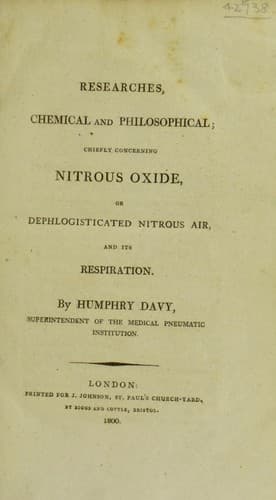
Researches Chemical and Philosophical; Chiefly concerning nitrous oxide: or dephlogisticated nitrous air and its respirationDavy, Humphry, Sir
Science
Researches Chemical and Philosophical; Chiefly concerning nitrous oxide: or dephlogisticated nitrous air and its respiration
Davy, Humphry, Sir
Nitrous oxide
_a._ Phosphorus introduced into pure nitrous oxide at common
temperatures, is not at all luminous. It is capable of being fused,
and even sublimed in it, without undergoing acidification, and without
effecting any alteration in its composition.
About 2 grains of phosphorus were fused, and gradually sublimed, in 2
cubic inches of pure nitrous oxide, over mercury, by the heat of a
burning lens. No alteration was produced in the volume of gas, and a
portion of it absorbed by water, left a residuum of one twelfth only.
Phosphorus was sublimed in pure nitrous oxide over mercury, in a
dark room, by an iron heated _nearly_ to ignition; but no luminous
appearance was perceptible, nor was any gas decomposed.
_b._ Phosphorus decomposes nitrous oxide at the temperature of
ignition, with greater or less rapidity, according to the degree of
heat. We have already seen, that when phosphorus in active inflammation
is introduced into nitrous oxide, it burns with intensely vivid light.
Phosphorus was sublimed by a heated wire in a jar filled with nitrous
oxide, standing over warm mercury. In this state of sublimation an iron
heated dull red was introduced to it by being rapidly passed through
the mercury; a light blue flame surrounded the wire, and disappeared as
soon as it ceased to be red.
To phosphorus sublimed as before, in nitrous oxide, over warm mercury,
a thick wire ignited to whiteness was introduced; a terrible detonation
took place, and the jar was shattered in pieces.
By employing thick conical jars,[172] containing only a small quantity
of nitrous oxide, I effected the detonation several times with safety;
but on account of the great expansion of the elastic products, the jar
was generally either raised from the mercury, or portions of gas were
thrown out of it. Hence I was unable to ascertain the exact changes
produced by this mode of decomposition.
[172] Experiments on the detonation of nitrous oxide with phosphorus
in this way require great attention. The detonating jar should be very
conical; the nitrous oxide employed should never equal more than one
eighth of the capacity of the jar. The wire for the inflammation must
be very thick, and curved so as to be easily introduced into the jar.
When ignited, it must be instantaneously passed through the heated
mercury into the jar.
Perhaps the electric spark might be advantageously applied for
detonating phosphoric vapor with nitrous oxide.
_c._ As my first attempts to ascertain the constitution of nitrous
oxide were made on its decomposition by phosphorus, I employed many
different modes of partially igniting this substance in it over
mercury, so as to produce a combustion without explosion.
Public-domain text, read in full here on John Shaqi.
Reviews
Reviews
No reviews yet
Be the first to share your thoughts on this work.
Elsewhere in the archive
Join the Discussion
Join the discussion
Sign in to leave a comment or review.
Sign InorCreate an account