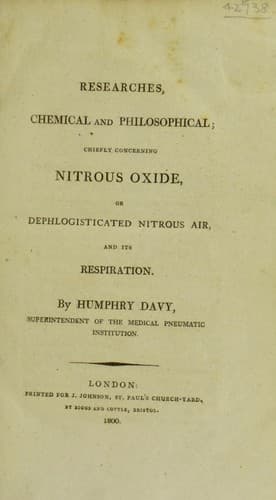
Researches Chemical and Philosophical; Chiefly concerning nitrous oxide: or dephlogisticated nitrous air and its respirationDavy, Humphry, Sir
Science
Researches Chemical and Philosophical; Chiefly concerning nitrous oxide: or dephlogisticated nitrous air and its respiration
Davy, Humphry, Sir
Nitrous oxide
_c._ From _E._ 1 it appears, that when a small quantity of
phosphorated hydrogene is inflamed with nitrous oxide, both the
phosphorus and hydrogene are consumed; whilst the superabundant
nitrous oxide, is converted into nitrous acid and atmospheric air,
by the ignition; or a certain quantity is partially decomposed into
atmospheric air by the combination of a portion of its oxygene with the
combustible gas.
From _E._ 2 we learn, that when the phosphorated hydrogene and nitrous
oxide are to each other as 25 to 10 nearly, they both disappear, whilst
nitrogene is evolved, and water and phosphoric acid produced. Reasoning
concerning the composition of nitrous oxide from this experiment,
we should conclude that it was composed of about 38 oxygene, and 62
nitrogene.
The result of _E._ 3 is interesting; we are taught from it that the
affinity of phosphorus for the oxygene of nitrous oxide is stronger
than that of hydrogene, at the temperature of ignition; so that when
phosphorated hydrogene is mingled with a quantity of nitrous oxide, not
containing sufficient oxygene to burn both its constituent parts, the
phosphorus only is consumed, whilst the hydrogene is liberated.
In repeating the experiments with phosphorated hydrogene that had
remained for some hours in the mercurial apparatus, I did not gain
exactly the same results; for a larger quantity of it was required to
decompose the nitrous oxide, than in the former experiments; doubtless
from its having deposited a portion of its phosphorus. They confirm,
however, the above mentioned conclusions.
In the course of experimenting, I passed the electric spark, for
a quarter of an hour, through about 60 measures of phosphorated
hydrogene. It underwent no alteration of volume. Phosphorus was
apparently precipitated from it, and it had wholly lost its power of
inflaming, in contact with common air.
VI. _Decomposition of Nitrous Oxide by Sulphur._
From the phænomena before mentioned,[177] relating to the combustion
of sulphur in nitrous oxide, it was evident that this gas was only
decomposable by it, at a much higher temperature than common air.
[177] Res. I. Div. III. S. II.
I introduced into sulphur in contact with nitrous oxide, over mercury
heated to 112°-114°, a wire intensely ignited. It lost much of its heat
in passing through the mercury, but still appeared red in the vessel.
The sulphur rapidly fused, and sublimed without being at all luminous.
This experiment was repeated five or six times, but in no instance
could the combustion of sulphur, by means of the ignited wire, be
effected.
I inflamed sulphur in nitrous oxide in the same manner as phosphorus;
namely, by introducing it into the small vessel filled with oxygene,
and igniting it by means of the heated wire. In these experiments the
sulphur burnt with a vivid rose-colored light, and much sulphuric, with
a little sulphureous acid, was formed.
Public-domain text, read in full here on John Shaqi.
Reviews
Reviews
No reviews yet
Be the first to share your thoughts on this work.
Elsewhere in the archive
Join the Discussion
Join the discussion
Sign in to leave a comment or review.
Sign InorCreate an account