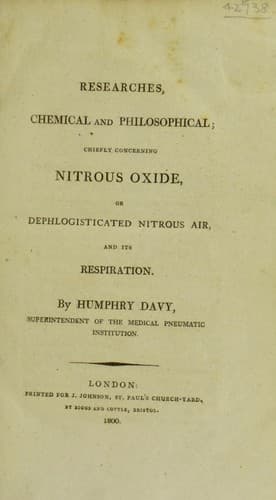
Researches Chemical and Philosophical; Chiefly concerning nitrous oxide: or dephlogisticated nitrous air and its respirationDavy, Humphry, Sir
Science
Researches Chemical and Philosophical; Chiefly concerning nitrous oxide: or dephlogisticated nitrous air and its respiration
Davy, Humphry, Sir
Nitrous oxide
Experimenting in this way I was never, however, able to decompose more
than one third of the quantity of nitrous oxide employed; not only the
nitrogene evolved, but likewise the sulphuric and sulphureous acids
produced, stopping the combustion.
I found that sulphur in a state of vivid inflammation, when introduced
into a mixture of one fourth nitrogene, and three fourths nitrous
oxide, burnt with a flame very much enlarged, and of a vivid rose
color. In one third nitrogene, and two thirds nitrous oxide, it burnt
feebly with a yellow flame. In equal parts of nitrous oxide and
nitrogene, it was instantly extinguished.
Sulphur burnt feebly, with a light yellow flame, when introduced
ignited into a mixture of 5 nitrous gas, and 6 nitrous oxide. In one
third nitrous oxide, and two thirds nitrous gas, it was instantly
extinguished. From many circumstances, I am inclined to believe that
sulphur is incapable, at any temperature, of slowly decomposing nitrous
oxide, so as to burn in it with a blue flame, forming sulphureous
acid alone. It appears to attract oxygene from it only when intensely
ignited, so as to form chiefly sulphuric acid, and that with great
rapidity, and vivid inflammation.
VII. _Decomposition of Nitrous Oxide by Sulphurated Hydrogene._
_a._ Though nitrous oxide and sulphurated hydrogene do not act
upon each other at common temperatures, yet they undergo a mutual
decomposition when mingled together in certain proportions, and ignited
by the electric spark.
From more than twenty experiments made on the inflammation of
sulphurated hydrogene in nitrous oxide, I select the following as the
most conclusive and accurate. The temperature at which they were made
was from 41° to 49°.
_b._ _E._ 1. About 35 measures of nitrous oxide were fired with 10
of sulphurated hydrogene; the expansion during inflammation was very
great, and the flame sky-blue. Immediately after, the gases filled
a space equal to 48 nearly. White fumes were then formed, and they
gradually contracted to 40. On the admission of a little strontian
lime water, a slight absorption took place, with white precipitation;
and the volume occupied by the residual gas nearly equalled 37. On
admitting nitrous gas to these, no perceptible diminution took place.
_E._ 2. 20 sulphurated hydrogene, with 25 nitrous oxide, could not be
inflamed.
30 nitrous oxide, with 22 sulphurated hydrogene, could not be inflamed.
35 nitrous oxide, with 20 sulphurated hydrogene, inflamed with vivid
blue light, and great expansion. After the explosion, the gases filled
exactly the same space as before the experiment; no white fumes were
perceived, and no farther contraction occurred. On the addition of
strontian lime water, a copious precipitation, with diminution, took
place; and the residual gas filled a space nearly equal to 35½.
Public-domain text, read in full here on John Shaqi.
Reviews
Reviews
No reviews yet
Be the first to share your thoughts on this work.
Elsewhere in the archive
Join the Discussion
Join the discussion
Sign in to leave a comment or review.
Sign InorCreate an account