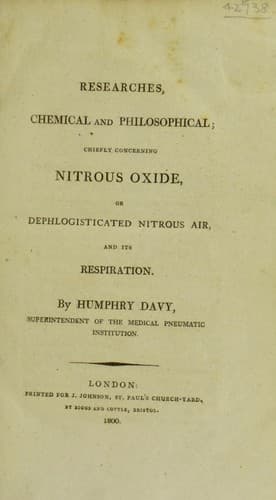
Researches Chemical and Philosophical; Chiefly concerning nitrous oxide: or dephlogisticated nitrous air and its respirationDavy, Humphry, Sir
Science
Researches Chemical and Philosophical; Chiefly concerning nitrous oxide: or dephlogisticated nitrous air and its respiration
Davy, Humphry, Sir
Nitrous oxide
Oxygene, which is capable of being respired for a much greater length
of time than any other gas, except common air, finally destroys life;
first producing changes in the blood, connected with new living
action.[185]
[184] As appears from the experiments of Dr. Beddoes; likewise those of
Mr. Watt.
[185] As appears from the experiments of Lavoisier and Dr. Beddoes; and
as will be seen hereafter.
After experiments, to be detailed hereafter, made upon myself and
others, had proved that nitrous oxide was respirable, and capable
of supporting life for a longer time than any of the gases, except
atmospheric air and oxygene, I was anxious to ascertain the effects of
it upon animals, in cases where its action could be carried to a full
extent; and to compare the changes occasioned by it in their organs,
with those produced by other powers.
II. _On the respiration of Nitrous Oxide by warm-blooded Animals._
The nitrous oxide employed in the following experiments, was procured
from nitrate of ammoniac, and received in large jars, filled with water
previously saturated with the gas. The animal was introduced into the
jar, by being carried under the water; after its introduction, the jar
was made to rest on a shelf, about half an inch below the surface of
the water; and the animal carefully supported, so as to prevent his
mouth from resting in the water.
This mode of experimenting, either under water or mercury, is
absolutely necessary, to ascertain with accuracy the effects of
pure gases on living beings. In some experiments that I made on the
respiration of nitrous oxide, by animals that were plunged into jars
of it opened in the atmosphere, and immediately closed after their
introduction, the unknown quantities of common air carried in, were
always sufficient to render the results perfectly inaccurate.
Animals suffer little or nothing by being passed through water.
That the phænomena in these experiments might be more accurately
observed, two or three persons were always present at the time of their
execution, and an account of them was noted down immediately after.
Public-domain text, read in full here on John Shaqi.
Reviews
Reviews
No reviews yet
Be the first to share your thoughts on this work.
Elsewhere in the archive
Join the Discussion
Join the discussion
Sign in to leave a comment or review.
Sign InorCreate an account