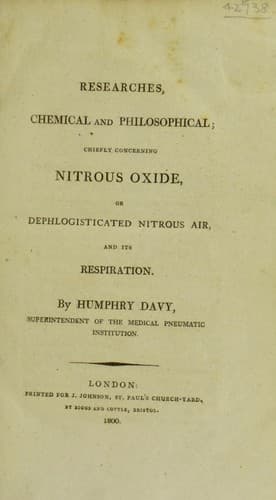
Researches Chemical and Philosophical; Chiefly concerning nitrous oxide: or dephlogisticated nitrous air and its respirationDavy, Humphry, Sir
Science
Researches Chemical and Philosophical; Chiefly concerning nitrous oxide: or dephlogisticated nitrous air and its respiration
Davy, Humphry, Sir
Nitrous oxide
NITROUS GAS is composed of about,56 oxygene, and,44 nitrogene, in
intimate union. It is soluble in twelve times its bulk of water, and
is combinable with the acids, and certain metallic solutions; it
is possessed of no acid properties, and is decomposable by most of
the bodies that attract oxygene strongly, at high temperatures. 100
cubic inches of it weigh about 34 grains, at the mean temperature and
pressure.
NITRIC ACID is a substance permanently aëriform at common temperatures,
composed of about 1 nitrogene, to 2,3 oxygene. It is soluble to a
great extent in water, and combinable with the alkalies, and nitrous
gas. It is decomposable by most of the combustible bodies, at certain
temperatures. 100 cubic inches of it weigh, at the mean temperature and
pressure, nearly 76 grains.
RESEARCH III.
RELATING TO THE RESPIRATION OF NITROUS OXIDE, AND OTHER GASES.
DIVISION I.
_EXPERIMENTS and OBSERVATIONS on the EFFECTS produced
upon ANIMALS by the RESPIRATION of NITROUS OXIDE._
I. _Preliminaries._
The term _respirable_, in its physiological application, has been
differently employed. Some times by the respirability of a gas has been
meant, its power of supporting life for a great length of time, when
repeatedly applied to the blood in the lungs. At other times all gases
have been considered as respirable, which were capable of introduction
into the lungs by voluntary efforts, without any relation to their
vitality.
In the last sense the word respirable is most properly employed. In
this sense it is used in the following sections.
Non-respirable gases are those, which when applied to the external
organs of respiration, stimulate the muscles of the epiglottis in inch
a way as to keep it perfectly close on the glottis; thus preventing
the smallest particle of gas from entering into the bronchia, in spite
of voluntary exertions; such are carbonic acid, and acid gases in
general.[183]
[183] See the curious experiments of Rosier, Journal de Physique, 1786,
vol. 1, pag. 419.
Of respirable gases, or those which are capable of being taken into the
lungs by voluntary efforts.
One only has the power of uniformly supporting life;—atmospheric air.
Other gases, when respired, sooner or later produce death; but in
different modes.
Some, as nitrogene and hydrogene, effect no positive change in the
venous blood. Animals immersed in these gases die of a disease produced
by privation of atmospheric air, analogous to that occasioned by their
submersion in water, or non-respirable gases.
Others, as the different varieties of hydrocarbonate, destroy life
by producing some positive change[184] in the blood, which probably
immediately renders it incapable of supplying the nervous and muscular
fibres with principles essential to sensibility and irritability.
Public-domain text, read in full here on John Shaqi.
Reviews
Reviews
No reviews yet
Be the first to share your thoughts on this work.
Elsewhere in the archive
Join the Discussion
Join the discussion
Sign in to leave a comment or review.
Sign InorCreate an account