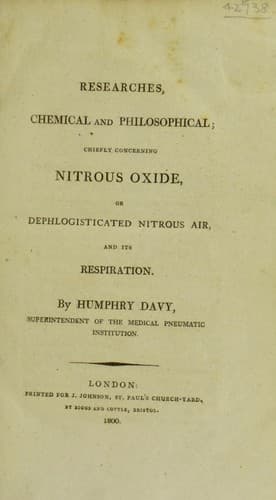
Researches Chemical and Philosophical; Chiefly concerning nitrous oxide: or dephlogisticated nitrous air and its respirationDavy, Humphry, Sir
Science
Researches Chemical and Philosophical; Chiefly concerning nitrous oxide: or dephlogisticated nitrous air and its respiration
Davy, Humphry, Sir
Nitrous oxide
In describing the various shades of color of the blood in the preceding
observations on the different dissected animals, the poverty of
the language of color, has obliged me to adopt terms, which I fear
will hardly convey to the mind of the reader, distinct notions of
the differences observable by minute examination in the venous and
arterial blood of animals that die of privation of atmospheric air,
and of those destroyed by the action of nitrous oxide. This difference
can only be observed in the vessels by means of a strong light; it
may however be easily noticed in the fluid blood by the introduction
of it from the arteries or veins at the moment of their incision,
between two polished surfaces of white glass,[186] so closely adapted
to each other, as to prevent the blood from coming in contact with the
atmosphere.
[186] The colour of common venous blood, examined in this way,
resembles that of the paint called by colour-men red ochre; that of
blood saturated with nitrous oxide, approaches to the tinge of lake.
Having four or five times had an opportunity of bleeding people in
the arm for trifling complaints, I have always received the blood in
phials, filled with various gases, in a mode to be described hereafter.
Venous blood agitated in nitrous oxide, compared with similar blood
in common air, hydrogene, and nitrogene, was always darker and more
purple than the first, and much brighter and more florid than the
two last, which were not different in their color from venous blood,
received between two surfaces of glass. It will be seen hereafter, that
the coagulum of venous blood is rendered more purple when exposed to
nitrous oxide, whilst the gas is absorbed; likewise that blood altered
by nitrous oxide, is capable of being again rendered vermilion, by
exposure to the air.
The appearances noticed in the above mentioned experiments, in the
lungs of animals destroyed in nitrous oxide, are similar to those
observed by Dr. Beddoes, in animals that had been made to breathe
oxygene for a great length of time.
There were many reasons for supposing that the large purple spots
in the lungs of animals destroyed in nitrous oxide, were owing to
extravasation of venous blood from the capillary vessels; their coats
being broken by the highly increased arterial action. To ascertain
whether these phænomena existed at a period of the action of nitrous
oxide, when the animal was recoverable by exposure to the atmosphere.
Public-domain text, read in full here on John Shaqi.
Reviews
Reviews
No reviews yet
Be the first to share your thoughts on this work.
Elsewhere in the archive
Join the Discussion
Join the discussion
Sign in to leave a comment or review.
Sign InorCreate an account