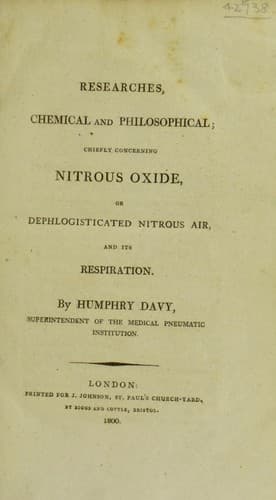
Researches Chemical and Philosophical; Chiefly concerning nitrous oxide: or dephlogisticated nitrous air and its respirationDavy, Humphry, Sir
Science
Researches Chemical and Philosophical; Chiefly concerning nitrous oxide: or dephlogisticated nitrous air and its respiration
Davy, Humphry, Sir
Nitrous oxide
Besides these animals, many others, as guinea-pigs, mice and birds,
were dissected after being destroyed in nitrous oxide; in all of them
the same general appearance was observed. Their muscular fibre almost
always appeared less irritable than that of animals destroyed, by
organic læsion of part of the nervous system, in the atmosphere. The
ventricles of the heart in general, contracted feebly and for a very
short time; whilst the auricles continued to act for a great length of
time. The lungs were dark in their appearance, and always suffused here
and there with purple; the blood in the pulmonary veins when slightly
observed, appeared dark, like venous blood, but when minutely examined,
was evidently much more purple. The blood in the vena cava, was darker
than that in the pulmonary veins. The cerebrum was dark.
In a late experiment, I thought I perceived a slight extravasation of
blood in one of the ventricles of the brain in a rabbit destroyed in
nitrous oxide; but as this appearance had not occurred in the animals
I had examined before, or in those dissected by Dr. Kinglake, and Mr.
King, Surgeon, I am inclined to refer it to an accidental cause. At my
request, Mr. Smith, Surgeon, examined the brain of a young rabbit that
had been killed in his presence in nitrous oxide; he was of opinion
that no effusion of blood into the ventricles had taken place.
In comparing the external appearance of the crural nerves in two
rabbits that had been dissected by Dr. Kinglake, having been destroyed
one in hydrogene, the other in nitrous oxide, we could perceive no
perceptible difference.
It deserves to be noticed, that whenever the gall bladder and the
urinary bladder have been examined in animals destroyed in nitrous
oxide, they have been always distended with fluid; which is hardly ever
the case in animals killed by privation of atmospheric air.
In the infancy of my experiments on the action of nitrous oxide upon
animals, I thought that it rendered the venous blood less coagulable;
but this I now find to be a mistake. The blood from the pulmonary
veins of animals killed in nitrous oxide, does not sensibly differ in
this respect from the arterial blood of those destroyed in hydrogene,
and both become vermilion nearly in the same time when exposed to the
atmosphere.
Public-domain text, read in full here on John Shaqi.
Reviews
Reviews
No reviews yet
Be the first to share your thoughts on this work.
Elsewhere in the archive
Join the Discussion
Join the discussion
Sign in to leave a comment or review.
Sign InorCreate an account