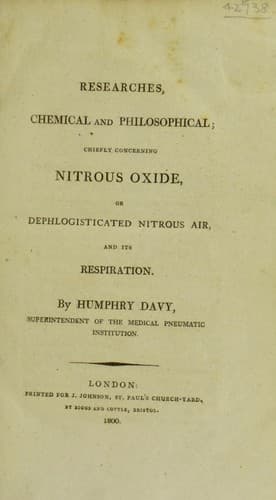
Researches Chemical and Philosophical; Chiefly concerning nitrous oxide: or dephlogisticated nitrous air and its respirationDavy, Humphry, Sir
Science
Researches Chemical and Philosophical; Chiefly concerning nitrous oxide: or dephlogisticated nitrous air and its respiration
Davy, Humphry, Sir
Nitrous oxide
The lizard in nitrous oxide, in two or three minutes, began to make
violent motions, appeared very uneasy, and rolled about the jar in
every direction, sometimes attempting to climb to the top of it. The
animal in hydrogene was all this time very quiet, and crawled about the
vessel without being apparently much affected. At the end of twelve
minutes, the lizard in nitrous oxide was lying on his back seemingly
dead; but on agitating the jar he moved a little; at the end of fifteen
minutes he did not move on agitation, and his paws were resting on his
belly. He was now taken out stiff and apparently lifeless, but after
being exposed to the atmosphere for three or four minutes, took an
inspiration, and moved his head a little; he then raised the end of his
tail, though the middle of it was still stiff and did not bend when
touched. His four legs remained close to his side, and were apparently
useless; but on pricking them with the point of a lancet, they became
convulsed. After being introduced into shallow water, he was able to
crawl in a quarter of an hour, though his motions were very irregular.
In an hour he was quite well. The animal in hydrogene appeared to have
suffered very little in three quarters of an hour, and had raised
himself against the side of the jar. At the end of an hour he was taken
out, and very soon recovered.
_b._ Some hours after, the same lizards were again experimented upon.
That which had been inserted into hydrogene in the last experiment,
being now inserted into nitrous oxide.
This lizard was apparently lifeless in fourteen minutes, having tumbled
and writhed himself very much during the first ten minutes. Taken out
after being in twenty-five minutes, he did not recover. The other
lizard lived in hydrogene for near an hour and quarter, taken out after
an hour and twenty minutes, he was dead.
These animals were both opened, but the viscera of the nitrous oxide
lizard were so much injured by the knife, that no accurate comparison
of them with those of the other could be made, I thought that the lungs
appeared rather redder.
_c._ Of two similar large water-lizards, one was introduced into a
vessel standing over mercury, wholly filled with water that had been
long boiled and suffered to cool under mercury.
The animal very often rose to the top of the jar as, if in search
of air, during the first half hour; but shewed no other signs of
uneasiness. At the end of three quarters of an hour, he became very
weak, and appeared scarcely able to swim in the water. Taken out at the
end of fifty minutes, he recovered.
The other was inserted into nitrous oxide. After much struggling,
he became senseless in about fifteen minutes, and lay on his back.
Taken out at the end of twenty minutes, he remained for a long time
motionless and stiff, but in a quarter of an hour, began to move some
of his limbs.
Public-domain text, read in full here on John Shaqi.
Reviews
Reviews
No reviews yet
Be the first to share your thoughts on this work.
Elsewhere in the archive
Join the Discussion
Join the discussion
Sign in to leave a comment or review.
Sign InorCreate an account