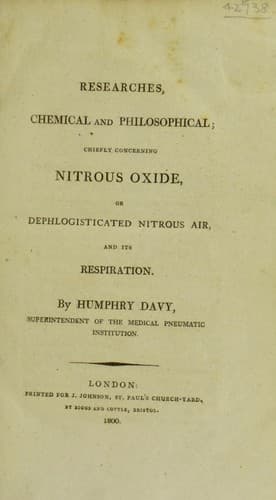
Researches Chemical and Philosophical; Chiefly concerning nitrous oxide: or dephlogisticated nitrous air and its respirationDavy, Humphry, Sir
Science
Researches Chemical and Philosophical; Chiefly concerning nitrous oxide: or dephlogisticated nitrous air and its respiration
Davy, Humphry, Sir
Nitrous oxide
From these experiments, we may conclude, that water-lizards, and most
probably the other amphibious animals, die in nitrous oxide in a much
shorter time than in hydrogene or pure water; consequently their death
in it cannot depend on the simple privation of atmospheric air.
At the season of the year in which this investigation was carried on, I
was unable to procure frogs or toads. This I regret very much.
Supposing that cold-blooded animals die in nitrous oxide from positive
changes effected in their blood by the gas, it would be extremely
interesting to notice the apparent alterations taking place in their
organs of respiration and circulation during its action, which
could easily be done, the membranous substance of their lungs being
transparent. The increase or diminution of the irritability of their
muscular fibre, might be determined by comparative galvanic experiments.
VIII. _Effects of solution of nitrous oxide in water on Fishes._
_a._ A small flounder was introduced into a vessel filled with solution
of nitrous oxide in water over mercury. He remained at rest for ten
minutes and then began to move about the jar in different directions.
In a half an hour he was apparently dying, lying on his side in the
water. He was now taken out, and introduced into a vessel filled with
water saturated with common air, he very soon recovered.
_b._ Of two large thornbacks,[188] equally brisk and lively. One, A,
was introduced into a jar containing nearly 3 cubic inches of water,
saturated with nitrous oxide, and which previous to its impregnation
had been long boiled; the other, B, was introduced into an equal
quantity of water which had been deprived of air by distillation
through mercury.
[188] I use the popular name. This fish is very common in every part of
England; it is nearly of the same size and color as the minnow, and is
distinguished from it by two small bony excresences at the origin of
the belly. It is extremely susceptible.
A, appeared very quiet for two or three minutes, and then began to move
up and down in the jar, as if agitated. In eight minutes his motions
became very irregular, and he darted obliquely from one side of the
jar to the other. In twelve minutes, he became still, and moved his
gills very slowly. In fifteen minutes he appeared dead. After sixteen
minutes he was taken out, but shewed no signs of life.
B was very quiet for four minutes and half. He then began to move
about the jar. In seven minutes he had fallen on his back, but still
continued to move his gills. In eleven minutes he was motionless; taken
out after thirteen minutes, he did not recover.
Public-domain text, read in full here on John Shaqi.
Reviews
Reviews
No reviews yet
Be the first to share your thoughts on this work.
Elsewhere in the archive
Join the Discussion
Join the discussion
Sign in to leave a comment or review.
Sign InorCreate an account