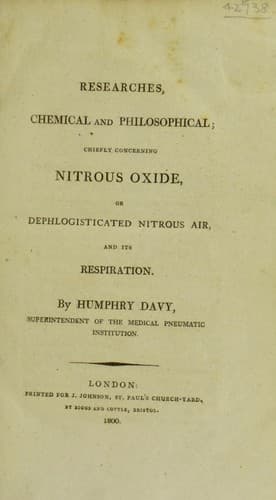
Researches Chemical and Philosophical; Chiefly concerning nitrous oxide: or dephlogisticated nitrous air and its respirationDavy, Humphry, Sir
Science
Researches Chemical and Philosophical; Chiefly concerning nitrous oxide: or dephlogisticated nitrous air and its respiration
Davy, Humphry, Sir
Nitrous oxide
I have before observed, that when animals are made to respire nitrous
oxide, a certain absorption of the gas always takes place; but the
smaller animals, the only ones that can be experimented upon in the
mercurial apparatus, die in nitrous oxide so speedily and occasion so
slight a diminution of gas, that I judged it useless to attempt to
analise the residuum of their respiration, which supports flame as well
as pure nitrous oxide, and is chiefly absorbable by water.
In the infancy of my researches, I often respired nitrous oxide in a
large glass bell, furnished with a breathing tube and stop-cock, and
poised in water saturated with the gas.
In two or three experiments in which the nostrils being closed after
the exhaustion of the lungs, the gas was inspired from the bell and
respired into it, a considerable diminution was perceived, and by the
test of lime water some carbonic acid appeared to have been formed; but
on account of the absorption of this carbonic acid by the impregnated
water, and the liberation of nitrous oxide from it, it was impossible
to determine with the least accuracy, the quantities of products after
respiration.
About this time likewise, I often examined the residuum of nitrous
oxide, after it had been respired in silk bags. In these experiments
when the gas had been breathed for a long time, a considerable
diminution of it was observed, and the remainder extinguished flame and
gave a very slight diminution with nitrous gas. But the great quantity
of this remainder as well as other phænomena, convinced me that
though the oiled silk was apparently air-tight when dry, under slight
pressure, yet during the action of respiration, the moist and warm gas
expired, penetrated through it, whilst common air entered through the
wetted surface.
To ascertain accurately, the changes effected in nitrous oxide by
respiration, I was obliged to make use of the large mercurial airholder
mentioned in Research I. of the capacity of 200 cubic inches. The upper
cylinder of it was accurately balanced so as to be constantly under the
pressure of the atmosphere. To an aperture in it, a stop-cock having
a very large orifice was adapted, curved and flattened at its upper
extremity, so as to form an air-tight mouth-piece.
Public-domain text, read in full here on John Shaqi.
Reviews
Reviews
No reviews yet
Be the first to share your thoughts on this work.
Elsewhere in the archive
Join the Discussion
Join the discussion
Sign in to leave a comment or review.
Sign InorCreate an account