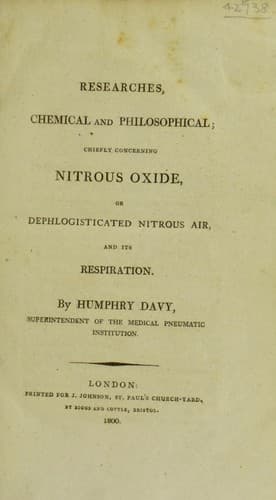
Researches Chemical and Philosophical; Chiefly concerning nitrous oxide: or dephlogisticated nitrous air and its respirationDavy, Humphry, Sir
Science
Researches Chemical and Philosophical; Chiefly concerning nitrous oxide: or dephlogisticated nitrous air and its respiration
Davy, Humphry, Sir
Nitrous oxide
_l._ To ascertain whether impregnation with nitrous oxide accelerated
or retarded the putrefaction of the blood; I exposed venous blood in
four phials, the first filled with hydrocarbonate, the second with
hydrogene; the third with atmospheric air, and the fourth with nitrous
oxide. Examined after a fortnight, the blood in hydrogene and common
air were both black, and stunk very much; that in hydrocarbonate was
red, and perfectly sweet; that in nitrous oxide appeared purple and had
no disagreeable smell.
In a second experiment, when blood was exposed for three weeks to
hydrocarbonate and nitrous oxide, that in nitrous oxide was darker than
before and stunk a little; that in hydrocarbonate was still perfectly
sweet. The power of hydrocarbonate to prevent the putrefaction of
animal matters, was long ago noticed by Mr. Watt.
_m._ Having accidentally cut one of my fingers so as to lay bare a
little muscular fibre, I introduced it whilst bleeding into a bottle of
nitrous oxide; the blood that trickled from the wound evidently became
much more purple; but the pain was neither alleviated or increased.
When however, the finger was taken out of the nitrous oxide and exposed
to the atmosphere, the wound smarted more than it had done before.
After it had ceased to bleed, I inserted it through water into a vessel
of nitrous gas; but it did not become more painful than before.
From all these observations, we may conclude,
1st. That when nitrous oxide is agitated in fluid
venous blood, a certain portion of the gas is
absorbed; whilst the color of the blood changes
from dark red to red purple.
2dly. That during the absorption of nitrous oxide by
the venous blood, minute portions of nitrogene and
carbonic acid are produced, either by evolution from
the blood, or from a decomposition of part of the
nitrous oxide.
3dly. That venous blood impregnated with nitrous oxide
is capable of oxygenation; and vice versa; that
oxygenated blood may be combined with nitrous oxide.
When blood separated into coagulum and serum, is exposed to nitrous
oxide, it is most probable that the gas is chiefly absorbed by the
serum. That nitrous oxide however is capable of acting upon the
coagulum, is evident from _d._ In the fluid blood, as we shall see
hereafter, nitrous oxide is absorbed by the attractions of the whole
compound.
III. _Of the changes effected in Nitrous Oxide by Respiration._
To ascertain whether the changes effected in nitrous oxide by the
circulating blood acting through the moist coats of the pulmonary
veins of living animals, were highly analogous to those produced in
it by fluid venous blood removed from the vessels, I found extremely
difficult.
Public-domain text, read in full here on John Shaqi.
Reviews
Reviews
No reviews yet
Be the first to share your thoughts on this work.
Elsewhere in the archive
Join the Discussion
Join the discussion
Sign in to leave a comment or review.
Sign InorCreate an account