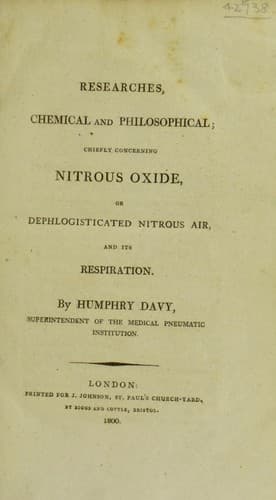
Researches Chemical and Philosophical; Chiefly concerning nitrous oxide: or dephlogisticated nitrous air and its respirationDavy, Humphry, Sir
Science
Researches Chemical and Philosophical; Chiefly concerning nitrous oxide: or dephlogisticated nitrous air and its respiration
Davy, Humphry, Sir
Nitrous oxide
The residual gas of an experiment was always examined in the following
manner. After being transferred through mercury into a graduated
cylinder, a small quantity of concentrated solution of caustic potash
was introduced to it, and suffered to remain in contact with it for
some hours; the diminution was then noted, and the quantity of gas
absorbed by the potash, judged to be carbonic acid. To the remainder,
twice its bulk of pure water was admitted. After agitation and rest for
four or five hours, the absorption by this was noticed, and the gas
absorbed considered as nitrous oxide. The residual unabsorbable gas
was mingled over water with twice its bulk of nitrous gas; and by this
means, its composition, whether it consisted wholly of nitrogene, or of
nitrogene mingled with small quantities of oxygene, ascertained.
From a number of experiments made at different times on the respiration
of nitrous oxide, I select the following as the most accurate.
E. 1. At temperature 54°, I breathed 102 cubic inches of nitrous oxide,
which contained near ¹/₅₀ common air, for about half a minute, seven
inspirations and seven expirations being made. After every expiration,
an evident diminution of gas was perceived; and when the last full
expiration was made, it filled a space equal to 62 cubic inches.
These 62 cubic inches analised, were found to consist of
Carbonic acid 3,2
Nitrous oxide 29,0
Oxygene 4,1
Nitrogene 25,7
————
62,0
————
Hence, accounting for the two cubic inches of common air previously
mingled with the nitrous oxide, 71 cubic inches had disappeared in this
experiment.
In the last respirations, the quantity of gas was so much diminished,
as to prevent the full expansion of the lungs; and hence the apparent
diminution was very much less after the first four inspirations.
E. 2. At temperature 47°, I breathed 182 cubic inches of nitrous oxide,
mingled with 2½ cubic inches of atmospheric air, which previously
existed in the airholder, for near 40 seconds; having in this time
made 8 respirations. The diminution after the first full inspiration,
appeared to a by-stander nearly uniform. When the last compleat
expiration was made, the gas filled a space equal to 128 cubic inches,
the common temperature being restored. These 128 cubic inches analised,
were found to consist of
Carbonic acid 5,25
Nitrous oxide 88,75
Oxygene 5,00
Nitrogene 29,00
Consequently, in this experiment, 93,25 cubic inches of nitrous oxide
had disappeared.
Public-domain text, read in full here on John Shaqi.
Reviews
Reviews
No reviews yet
Be the first to share your thoughts on this work.
Elsewhere in the archive
Join the Discussion
Join the discussion
Sign in to leave a comment or review.
Sign InorCreate an account